For millions of Outlander fans worldwide, Scotland is more than just a backdrop – it's a character in its own right. The hit Starz series, based on Diana Gabaldon's bestselling novels, follows Claire Randall, a World War II nurse who is mysteriously transported back to 1743 Scotland, where she meets and falls in love with Highland warrior Jamie Fraser. What unfolds is an epic tale of love, loyalty and survival set against some of the most turbulent chapters in Scottish history.
Since the show first aired in 2014, what's become known as "The Outlander Effect" has transformed Scottish tourism. A 2024 VisitScotland report found that visitor numbers at filming locations have surged dramatically – Blackness Castle, for example, saw attendance leap from 16,559 in 2014 to over 77,000 in 2024. One in five tourists now say they've been inspired by film and TV when choosing to visit Scotland.
Janette and I have always loved Outlander, and we've spent time exploring many of the filming locations across Scotland. What struck us most was how the real history of these places is every bit as dramatic as the fiction. From medieval castles and ancient burghs to atmospheric kirkyards and wild Highland glens, the locations chosen by the production team are genuinely special – and all of them are open to visitors.

Outlander and Scotland – A Love Story
The relationship between Outlander and Scotland runs far deeper than mere scenery. Diana Gabaldon set her novels squarely in the Scottish Highlands during one of the most dramatic periods in the nation's history – the Jacobite risings of the 18th century. When the television adaptation came along, the production team made the decision to film almost entirely on location in Scotland, using real castles, villages and landscapes to bring Gabaldon's world to life.
The result has been extraordinary. Screen tourism was estimated to be worth £161 million to Scotland in 2023 alone, and Outlander has been the single biggest driver. Filming locations are scattered across the country, from the Central Belt to the Highlands, meaning that fans following the Outlander trail end up discovering parts of Scotland they might never have otherwise visited. Locations like Doune Castle saw visitor numbers rise by over 150% in the decade following the show's premiere, while the once-quiet Preston Mill in East Lothian experienced a staggering 6,000% increase.
With the prequel series Outlander: Blood of My Blood – which premiered in August 2025 and follows the parents of Jamie and Claire – already renewed for a second season and filming in Scotland, the Outlander effect shows no sign of slowing down.
The Major Filming Locations
Doune Castle – Castle Leoch
If there's one location that defines Outlander in the minds of fans, it's Doune Castle. This magnificently preserved 14th-century stronghold, situated five miles northwest of Stirling, serves as the fictional Castle Leoch – the seat of Clan MacKenzie and the place where Claire first meets Colum MacKenzie after being thrown back in time.

The castle played a prominent role throughout season one and returned for the prequel Blood of My Blood, once again standing in for Castle Leoch. Its imposing 100-foot gatehouse is instantly recognisable, and walking through the courtyard feels like stepping directly into the series. Inside, the cathedral-like great hall with its central hearth and minstrels' gallery is genuinely impressive – it's easy to imagine the MacKenzie clan gathering here for one of Colum's great feasts.
Originally built in the late 13th century, the castle was badly damaged during the Scottish Wars of Independence before being rebuilt by Robert Stewart, Duke of Albany, in the late 14th century. It was also held briefly by Bonnie Prince Charlie during the 1745 Jacobite rising – a fitting connection given Outlander's storyline. The castle has appeared in other notable productions too, including Monty Python and the Holy Grail and the pilot episode of Game of Thrones, where it served as Winterfell.
An audio tour narrated by Sam Heughan (Jamie Fraser himself) is available, offering behind-the-scenes insights into how the castle was transformed for filming. Don't miss the walk along the meandering path outside the curtain walls, where you can look down upon the River Teith – a lovely spot for a picnic.
Doune Castle is managed by Historic Environment Scotland. Entrance is free for Historic Scotland and English Heritage members. An Explorer Pass covering multiple sites is also available and well worth considering if you're planning to visit several locations on this list.
Blackness Castle – Fort William
Perched dramatically on the rocky shoreline of the Firth of Forth, about sixteen miles west of Edinburgh, Blackness Castle is one of the most atmospheric filming locations on the Outlander trail. This 15th-century fortress doubles as the fictional Fort William – the notorious garrison commanded by the villainous Black Jack Randall.

The castle features in several of the series' most harrowing scenes. In season one, this is where Randall has Jamie flogged in the courtyard while his father and fellow Highlanders are forced to watch – scenes that are genuinely difficult to watch and linger long in the memory. Later, Claire is held captive within these walls before Jamie breaks in to rescue her. The castle also reappears in season two, when Jamie's daughter Brianna explores the grounds and feels an unexplained connection to the place.
The castle's distinctive ship-like profile – narrow and elongated as it follows the rocky promontory – has earned it the nickname "the ship that never sailed." Built in the 1440s by Sir George Crichton, it was seized by King James II in 1453 and subsequently served as a garrison fortress, state prison and ammunition depot for over 400 years. Climb the towers and curtain wall for sweeping views across the Firth of Forth towards the three Forth bridges – the magnificent cantilever Forth Rail Bridge (opened 1890), the Forth Road Bridge (1964) and the modern Queensferry Crossing (2017).
Blackness Castle is managed by Historic Environment Scotland. If you're looking for somewhere to eat afterwards, the Lobster Pot pub and restaurant in the nearby village is worth trying.
Culross – The Village of Cranesmuir
The Royal Burgh of Culross in Fife is one of Scotland's most perfectly preserved 16th and 17th-century villages, and it's easy to see why the Outlander production team chose it as the fictional village of Cranesmuir. Walking through its narrow cobbled streets, past white-harled houses with distinctive red-tiled roofs, genuinely feels like stepping back in time.

Several key Outlander scenes were filmed here. Culross serves as the village where Claire meets the herbalist Geillis Duncan and the fearsome Father Bain. In the town's small square, complete with its Mercat Cross, Jamie – with a little help from Claire – aids a boy whose ear has been nailed to the pillory. Fans will also want to visit the gardens behind Culross Palace, which stand in beautifully for Claire's herb garden at Castle Leoch.
Beyond its Outlander connections, Culross is a fascinating place to explore in its own right. The village was once a thriving centre of trade, and the National Trust for Scotland has done remarkable work preserving its heritage. The ochre-coloured Culross Palace (which is actually a merchant's house rather than a true palace) and its terraced gardens overlooking the Firth of Forth are well worth your time. The ruined Black Kirk, a short walk from the village centre, also appears briefly in the series.
For lunch, try the bar food at the Red Lion pub, where there's a good selection of draught beers. Alternatively, the Biscuit Café serves snacks and excellent home bakes – the triple chocolate fudge cake is dangerously good.
Falkland – 1940s Inverness
The picturesque village of Falkland in Fife, nestled at the foot of the Lomond Hills about 39 miles from Edinburgh, is where Outlander's story truly begins. The production team transformed this charming village into 1940s Inverness for the series' opening scenes, where Claire and Frank arrive for their second honeymoon at the end of the Second World War.
The village square is instantly recognisable to fans. The Fayre Earth gift shop appears as Farrell's furniture store, where Claire admires a blue vase in the window. The ornamental Bruce Fountain, built in 1856, provides a perfect photo opportunity – this is where Frank catches a glimpse of Jamie's ghost staring up at Claire brushing her hair in their guesthouse window, one of the series' most eerie and memorable moments.
The Covenanter Hotel served as the exterior of Mrs Baird's B&B, where Frank and Claire stay. While the interior shots were filmed in a studio, the exterior looks exactly as it does in the show, and you can actually book a room here for an authentic Outlander experience. The hotel features a restaurant and coffee shop serving home bakes during the day, and in the evening the bar offers log fires and a fine selection of Scottish whisky – the perfect setting to toast Jamie Fraser.
While you're here, a visit to Falkland Palace is well worth your time. Once a favourite residence of the Stewart monarchs, the palace offers a glimpse into Scotland's turbulent royal history. One of the East Range cellars was also transformed into the apothecary scene where Claire encounters Mary Hawkins in season two.
Linlithgow Palace – Wentworth Prison
Linlithgow Palace is one of Scotland's most magnificent ruins, and one of my personal favourite places to visit. Situated 21 miles west of Edinburgh, this majestic royal residence was the birthplace of Mary Queen of Scots in 1542 and served as a principal seat of the Scottish monarchy throughout the 15th and 16th centuries.

In Outlander, however, this beautiful palace takes on a far darker role. Its corridors and dungeons serve as the fictional Wentworth Prison, where Jamie suffers grievously at the hands of Black Jack Randall in one of the first season's most harrowing sequences. It's a testament to the versatility of this location that a place so elegant in reality could be made to look so menacing on screen.
Beyond its Outlander connections, there is so much to explore here. The Great Hall built by James I, the royal apartments added by James IV, and the stunning three-tiered courtyard fountain installed by James V in 1538 are all highlights. The palace sits within attractive parkland surrounding a loch, where you can enjoy a peaceful walk, watch the birdlife, or settle down for a picnic. An annual jousting spectacular is held each summer, harking back to medieval tournaments on the Peel.
Linlithgow Palace is managed by Historic Environment Scotland. Adult admission is approximately £9.
The Highland Folk Museum – 18th-Century Township
The Highland Folk Museum in Newtonmore, situated 45 miles south of Inverness in the heart of the Cairngorms, is one of the most immersive Outlander filming locations you can visit. This open-air museum was used extensively in season one, episode five ("Rent"), when Jamie and Claire accompany Dougal MacKenzie to collect taxes for the clan.

The museum is set across an 80-acre site covering life in the Highlands from 1700 to the present day. The star attraction for Outlander fans is Baile Gean (Gaelic for "Township of Goodwill"), a cluster of 17th-century blackhouses built using traditional methods to recreate an authentic Highland settlement. The scene where the women sit around a table singing with Claire as they dye cloth was filmed right here, and walking through the township with the magnificent Cairngorm mountains as a backdrop is genuinely transporting.
The museum has continued to feature in the series – the opening credits of Outlander use footage filmed here, and production crews have returned for later seasons. Human re-enactors dressed in period costume bring the township to life and are happy to answer questions about both the museum and Outlander.
Beyond the Outlander connection, there's plenty more to see – Aultlarie Farm, Leanach Church, a 1930s schoolroom complete with desks and school bell, and an old-fashioned post office and sweet shop with jars of traditional sweets. There's a café for snacks and a shop with gifts and souvenirs, plus a picnic area and children's play area. Best of all, admission to the Highland Folk Museum is completely free, though donations are encouraged. The museum is open from April to October.
More Filming Locations to Explore
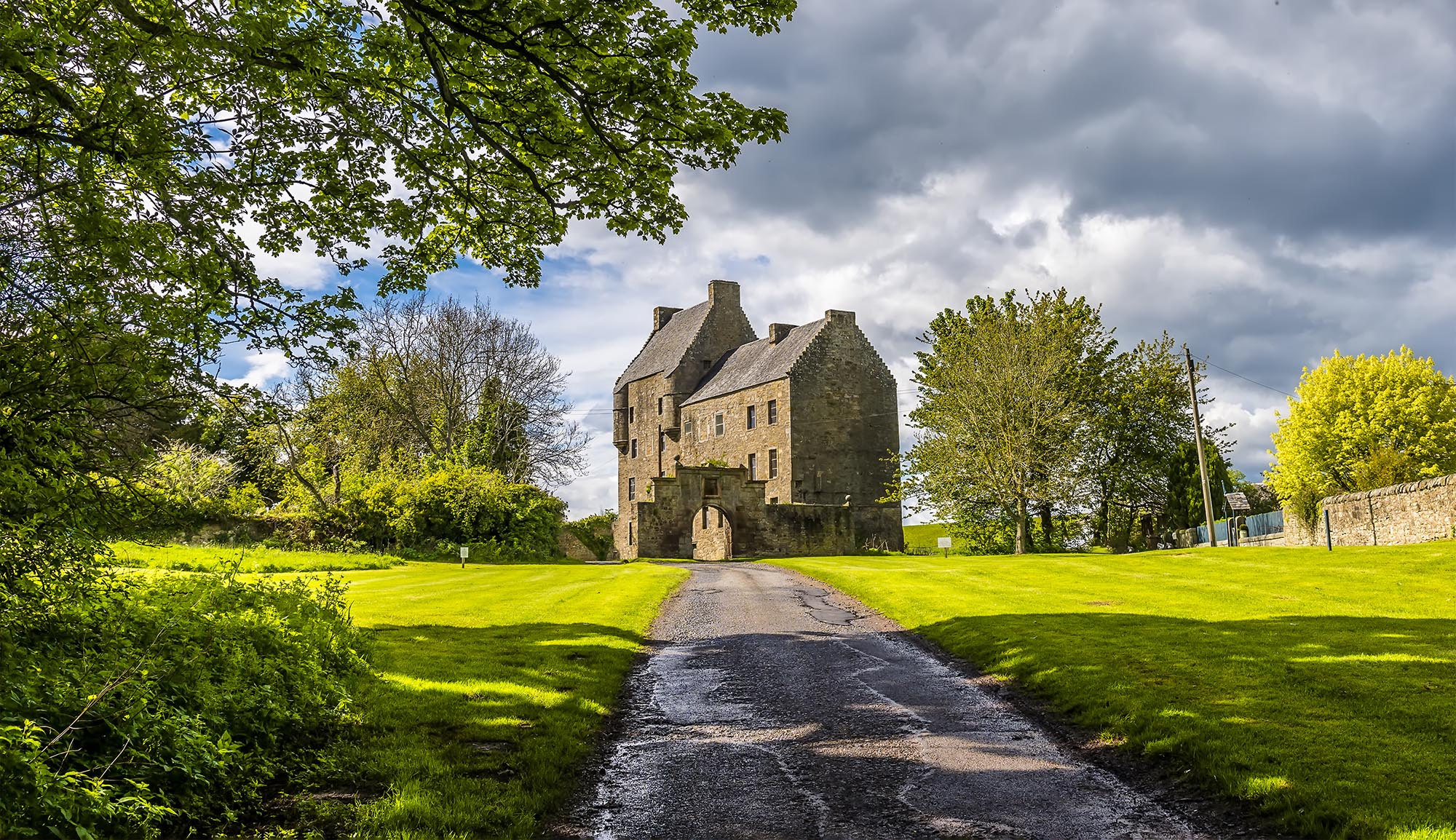
Midhope Castle – Lallybroch (Jamie's Home)
Midhope Castle, located on the grounds of the Hopetoun Estate near Edinburgh, is the filming location for Lallybroch – Jamie Fraser's beloved ancestral home and one of the most emotionally significant locations in the series. The exterior of this 15th-century tower house is instantly recognisable to fans from its appearances across seasons one to four. Although the interior is derelict and inaccessible, you can walk through the courtyard where Claire first meets Jamie's sister Jenny.
As this is a residential farm on a private estate, you'll need to obtain a visitor pass from the farm shop before visiting. Access is occasionally restricted for filming or farming operations, so it's worth checking in advance.

Hopetoun House – The Duke of Sandringham's Residence
Just nearby, the grand Hopetoun House served as the Duke of Sandringham's lavish residence in season one. This elegant Georgian mansion, set on its own 6,500-acre estate on the shores of the Firth of Forth, perfectly captures the opulence and aristocratic world that contrasts so starkly with Highland life in the series. Hopetoun House is open to visitors between April and September.
Beauly Priory
This picturesque priory in the village of Beauly, north of Inverness, was founded in 1230 by the Valliscaulian order of monks. It was used as a filming location in season two, when Claire meets the seer Maisri. Read more about Beauly Priory.

Bo'ness and Kinneil Railway
The Bo'ness and Kinneil Railway and Museum of Scottish Railways sits on the south bank of the Firth of Forth, approximately 18 miles west of Edinburgh. Operated by volunteer rail enthusiasts from the Scottish Railway Preservation Society, the station was transformed by the Outlander team into a wartime London station for the romantic scene where Claire and Frank say their goodbyes as Claire leaves for the war to use her nursing skills.
You can explore this fascinating railway site, board a vintage steam train and travel in an old-fashioned, Harry Potter-style coach with individual compartments. Afternoon tea experiences are available with advance booking. There are also special Thomas the Tank Engine theme days for younger children.
Bakehouse Close, Edinburgh – Jamie's Print Shop
Tucked away off Canongate near the historic Royal Mile, Bakehouse Close is where one of Outlander's most iconic scenes takes place – the emotional reunion of Claire and Jamie after 20 years apart in season three. In the show, this atmospheric close becomes Carfax Close, home to "A. Malcolm's" print shop. The archway above dates back to 1570, and standing in the close, it's not hard to imagine you're in 18th-century Edinburgh. The production crew transformed the exterior with barrels, ropes and carts, but the location is still instantly recognisable without them.
Craigmillar Castle – Ardsmuir Prison
One of Edinburgh's best-preserved medieval castles, Craigmillar served as the grim Ardsmuir Prison where Jamie is incarcerated after the Battle of Culloden. The castle sits on a hill just south of the city centre with commanding views across Edinburgh. It has deep royal connections too – Mary Queen of Scots took refuge here in 1566, and it's believed the plot to murder her husband Lord Darnley was hatched within these walls. Managed by Historic Environment Scotland, it's well worth combining with a visit to Bakehouse Close for an Edinburgh-based Outlander day.

Glencorse Old Kirk – Jamie and Claire's Wedding
This atmospheric ruined church in the Pentland Hills, just south of Edinburgh, is where Jamie and Claire tie the knot in one of the series' most beloved scenes. The small, simple kirk provides the perfect intimate setting for their wedding ceremony. Note that Glencorse Old Kirk is managed by Historic Churches Scotland and access is by arrangement.
Drummond Castle Gardens – The Palace of Versailles
When the story moves to France in season two, the production team needed a location grand enough to stand in for the Palace of Versailles. They found it in the formal gardens of Drummond Castle near Crieff in Perthshire. These stunning 17th-century gardens, considered among the finest in Europe, provided the backdrop for scenes set at the French royal court during the time of Louis XV.
Dean Castle – Beaufort Castle
Dean Castle Country Park in Kilmarnock was used in season two as Beaufort Castle, the seat of Clan Fraser of Lovat – Jamie's grandfather Lord Lovat, the man who refused to leave his home when Jamie asked for men to support Bonnie Prince Charlie. The castle was originally given to the Boyd family by Robert the Bruce for their service during the Wars of Independence.
Gosford House – Multiple Locations
This neoclassical mansion in East Lothian, two miles northeast of Longniddry, served as a versatile filming location across seasons two and three, appearing as the interiors of Ellesmere, Helwater and Versailles Palace.
Finnich Glen (The Devil's Pulpit) – Liar's Spring
This dramatic deep gorge near Killearn, north of Glasgow, became the mystical Liar's Spring in season one. The narrow canyon with its moss-covered walls and distinctive red-tinged water (caused by the red sandstone riverbed) creates an otherworldly atmosphere. Note that the glen can be slippery and potentially dangerous – joining a guided tour is recommended over visiting alone.
Craigh na Dun – Where are the Standing Stones?
This is perhaps the most asked-about Outlander location of all, and the answer may come as a disappointment to some – Craigh na Dun is entirely fictional. The iconic standing stones that transport Claire back through time were sculpted from Styrofoam, painted to look real, and placed on private land near Kinloch Rannoch in Highland Perthshire.
The exact filming location is on a working farm, and while the family has made some accommodations for fans (including a small car park), the site is not a tourist attraction and there are no facilities. You'll need permission from the landowners to enter the property, and the area is remote – far from most other Outlander locations.
If you want a similar experience at a genuine ancient site, consider visiting Clava Cairns near Inverness. This exceptionally well-preserved Bronze Age burial site, dating back some 4,000 years, is widely believed to have been Diana Gabaldon's original inspiration for Craigh na Dun. The cairns, standing stones and stone circles are free to visit and genuinely atmospheric. Scotland has around 500 stone circles scattered across the country, so you're never too far from one.

Where to eat near Kinloch Rannoch?
Try the Riverbank Café on Allt Mor Place – very friendly, with freshly filled rolls, homemade soups and excellent cake.
The North Carolina Filming Locations
While the fictional Claire and Jamie are living in colonial North Carolina in the later seasons, the scenes were actually filmed entirely in Scotland. The Scottish landscape proved remarkably versatile in standing in for the American colonies.
River Run (Jocasta's Plantation) was filmed at Abercairny Estates, about 60 miles north of Glasgow near Crieff. The plantation house was built from scratch on the estate grounds, though only the lower half was physically constructed – the upper portion was computer-generated. The estate is private, but occasional open days allow visits.
Fraser's Ridge was filmed near Hill of Row, close to Doune. The Trossachs National Park, with its existing woodlands enhanced with extra ferns and strawberry bushes, provided the lush forest backdrop. The rolling hills and dense woodland of Highland Perthshire, including the Hermitage near Dunkeld and Faskally Forest, also feature in the later seasons.
Governor Tryon's Residence was filmed at Newhailes House in Musselburgh, near Edinburgh. This 17th-century Palladian mansion saw perhaps the most dramatic visitor increase of any Outlander location – from just 4,831 visitors in 2014 to over 304,000 in 2024.
Frequently Asked Questions
How many seasons of Outlander are there?
Outlander ran for eight seasons on Starz, with the final season expected to air in 2026. A prequel series, Outlander: Blood of My Blood, premiered in August 2025 and has already been renewed for a second season. Blood of My Blood follows the parents of Jamie and Claire and was also filmed extensively in Scotland, including at Doune Castle.
Do I need a car to visit the filming locations?
A car is the most practical way to explore the locations, particularly the Highland Folk Museum and Kinloch Rannoch. However, many Central Belt locations (Doune Castle, Blackness, Culross, Linlithgow, Falkland) can be reached by a combination of train and bus from Edinburgh. Several tour operators run dedicated Outlander day trips from Edinburgh and Glasgow – companies like Rabbie's, Highland Explorer Tours and Silverscreen Tours all offer well-reviewed group tours that cover multiple locations in a single day.
How many days do I need to see the main locations?
You could visit four to six locations in a full day if you focus on one area. For a comprehensive Outlander tour covering the Central Belt locations, the Highlands and Edinburgh, plan for three to five days. VisitScotland publishes a 12-day Outlander itinerary that covers locations from seasons one to four.
Is a Historic Scotland membership worth it?
If you're planning to visit three or more Historic Environment Scotland sites (which includes Doune Castle, Blackness Castle, Linlithgow Palace and Craigmillar Castle), a membership or Explorer Pass will save you money. English Heritage members also receive free entry to all Historic Scotland sites.
Can I visit Lallybroch (Midhope Castle)?
Yes, but access is limited. Midhope Castle is on the private Hopetoun Estate and you'll need a visitor pass from the farm shop. The castle is occasionally closed for filming or estate operations, and there is a winter closure period (typically January to late February). Only the exterior and courtyard are accessible – the interior is derelict.
Are the standing stones from Craigh na Dun real?
No, the standing stones were made from Styrofoam and placed on private farmland near Kinloch Rannoch. If you want to visit a genuine ancient stone circle that's believed to have inspired Gabaldon, head to Clava Cairns near Inverness – it's free to visit and genuinely atmospheric.
What's the best time of year to visit?
Late spring (May to June) and early autumn (September) offer the best combination of reasonable weather and manageable crowds. The Highland Folk Museum is only open from April to October. Summer months bring the longest daylight hours but also the busiest attractions. Winter visits mean some sites have reduced hours, but you'll have many locations largely to yourself.
Key Information
- Main Filming Areas: Central Belt (Stirling, Fife, West Lothian), Edinburgh, Highland Perthshire
- Doune Castle: Historic Environment Scotland – free for members, Explorer Pass accepted
- Blackness Castle: Historic Environment Scotland – free for members, Explorer Pass accepted
- Linlithgow Palace: Historic Environment Scotland – approximately £9 adult admission
- Culross Palace: National Trust for Scotland – approximately £10.50 adult admission (closed in winter)
- Highland Folk Museum: Free admission (open April–October)
- Midhope Castle (Lallybroch): Hopetoun Estate – visitor pass required from farm shop
- Official Resource: VisitScotland Outlander filming locations map (covers seasons 1–4)
Conclusion
Whether you're a devoted Outlander fan or simply someone who appreciates Scotland's remarkable history and landscapes, the filming locations offer a wonderful way to explore the country. What makes these places special is that they aren't just film sets – they're real castles, real villages and real landscapes with centuries of genuine history woven through them. The stories that happened within the walls of Doune Castle, Linlithgow Palace and Blackness are every bit as dramatic as anything in the Outlander series.
I hope this guide has been helpful for planning your own Outlander adventure around Scotland. Whatever route you take, you'll discover that the real Scotland is every bit as magical as the fictional one.
Further reading:
All information was correct at the time of writing, please check things like entry costs and opening times before you arrive.


Leave a comment below