For millions of Harry Potter fans worldwide, Scotland holds a very special place in their hearts. While Hogwarts may be a fictional school of witchcraft and wizardry, the magnificent Scottish Highlands provided the breathtaking backdrop for much of the magic we see on screen. From the iconic viaduct that carries the Hogwarts Express to the dramatic glen where Hagrid’s hut once stood, Scotland’s wild and ancient landscapes were chosen by filmmakers to bring J.K. Rowling’s vision to life.
Janette and I have always been Potter fans, and we finally made the pilgrimage to the Scottish Highlands to explore these enchanting filming locations. What we discovered was not only movie magic but also some of the most spectacular scenery Scotland has to offer – landscapes that feel genuinely magical even without a wand in hand.

Harry Potter and Scotland – The Magical Connection
The connection between Harry Potter and Scotland runs deep. J.K. Rowling wrote much of the early books whilst living in Edinburgh, finding inspiration in the city’s medieval architecture, atmospheric graveyards, and gothic atmosphere. Although the castle interiors were filmed at various locations in England, the production team consistently returned to Scotland for the dramatic exterior shots that gave Hogwarts its wild, remote character.
In the Harry Potter novels, Hogwarts is explicitly located in Scotland. Students board the Hogwarts Express at King’s Cross Station in London and travel north for an entire day before arriving at their destination. Rowling has confirmed in interviews that she always imagined Hogwarts to be somewhere in the Scottish Highlands – that misty, mountainous region where ancient magic might still linger.
The Scottish locations were first used extensively in Harry Potter and the Prisoner of Azkaban (2004), when director Alfonso Cuarón relocated the Hogwarts grounds to the Highlands. This darker, more atmospheric third film established the rugged Scottish landscape as an integral part of the Harry Potter visual identity, and subsequent films continued to use these locations.

Our Visit – Exploring the Filming Locations
Glenfinnan Viaduct – The Harry Potter Bridge
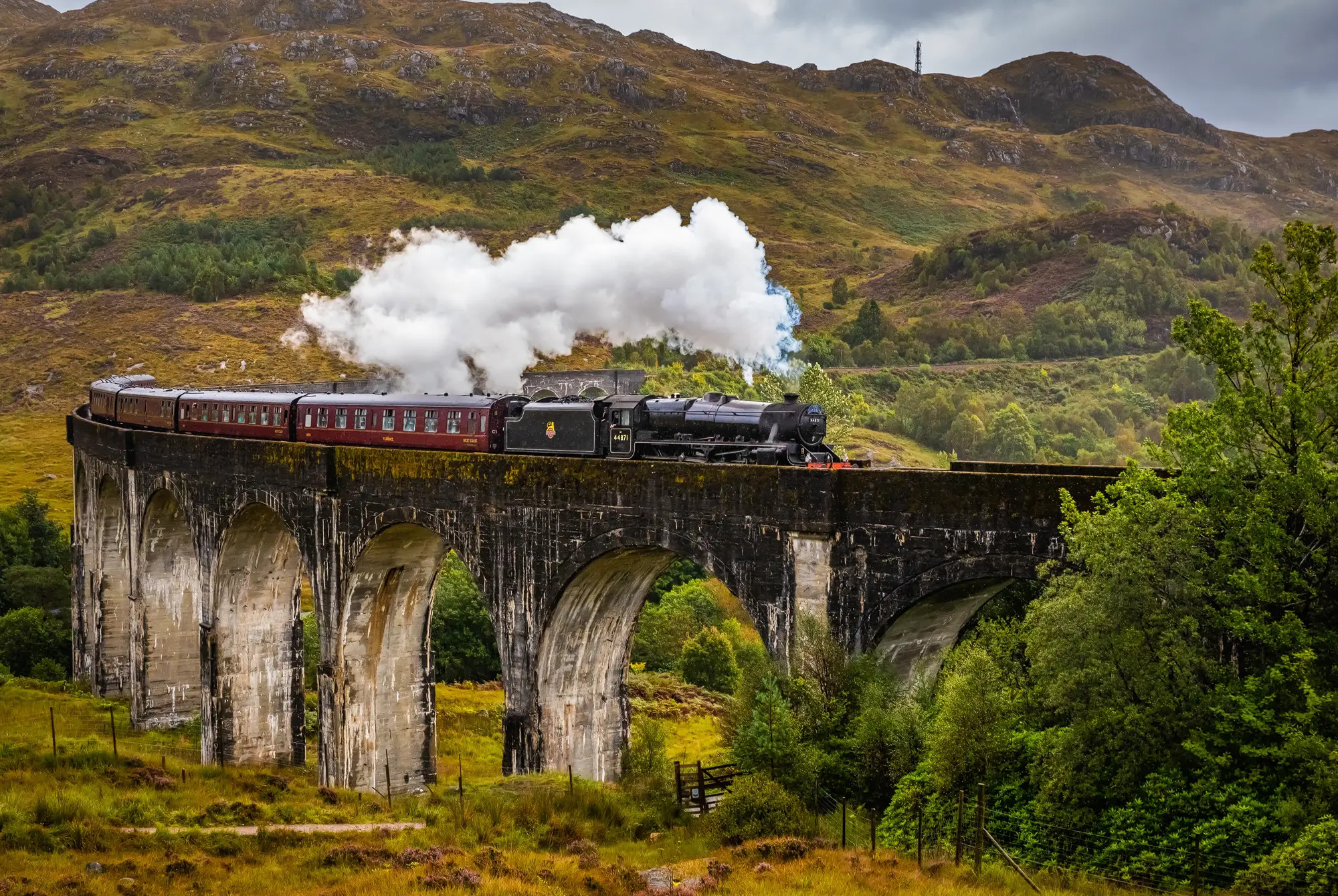
No Harry Potter pilgrimage to Scotland would be complete without visiting the Glenfinnan Viaduct – perhaps the most iconic filming location of all. This magnificent railway bridge features in four of the eight films and has become so synonymous with Harry Potter that it’s affectionately known as “the Harry Potter Bridge”.
Janette and I arrived at the National Trust for Scotland car park on a typically Scottish day – sunshine battling with cloud, with that wonderful fresh Highland air that makes everything feel cleaner. The car park costs around £3-4 and fills up quickly in summer, so arriving early is essential. We made our way along the well-marked trail towards the western viewpoint, a walk of about 15-20 minutes with some uphill sections.
The viaduct itself is an impressive piece of Victorian engineering, built between 1897 and 1901 by Robert McAlpine – nicknamed “Concrete Bob” for his innovative use of mass concrete in construction. Standing 100 feet high with 21 graceful arches curving across the glen, it’s genuinely breathtaking. The fact that it’s still an active railway line carrying the Jacobite steam train (the real-life “Hogwarts Express”) adds to the magic.

Fans will instantly recognise this location from the flying Ford Anglia scene in Harry Potter and the Chamber of Secrets, when Harry and Ron narrowly avoid crashing into the train. We timed our visit to coincide with the passing of the Jacobite steam train – watching that beautiful locomotive puff across the viaduct, trailing white steam against the Highland sky, was genuinely spine-tingling.
Loch Shiel – The Black Lake
Just across the road from the Glenfinnan Viaduct viewpoint lies Loch Shiel, the stunning freshwater loch that served as Hogwarts’ Black Lake (also called the Great Lake) in the films. This 28-kilometre loch, surrounded by mountains, appears in five of the eight Harry Potter movies.
We first see Loch Shiel in The Philosopher’s Stone when the first-year students arrive at Hogwarts by boat. It appears again during the Triwizard Tournament in The Goblet of Fire when the champions must rescue their loved ones from the lake’s depths. Looking out across the dark, still waters flanked by brooding mountains, it’s easy to imagine merpeople and giant squids lurking beneath the surface.

The Glenfinnan Monument, commemorating the 1745 Jacobite rising, stands at the head of the loch and provides a perfect foreground for photographs. From the hillside viewpoint above the visitor centre, you can see both the viaduct and the loch in one stunning panorama.
Glencoe – Hagrid’s Hut
Our next stop was Glencoe, one of Scotland’s most dramatic and historically significant glens. This U-shaped valley, carved by ancient glaciers and scarred by one of Scottish history’s most notorious massacres in 1692, provided the backdrop for Hagrid’s hut in the films.
In May and June 2003, the production team built three full-scale sets near Clachaig Inn at the bottom of Clachaig Gully: Hagrid’s Hut complete with pumpkin patch, the Sundial Garden where Hermione punches Draco, and the “Bridge to Nowhere” leading to Hogwarts. The location was chosen for its spectacular views over Torren Lochan and the Signal Rock forest.

Although the sets have long been dismantled and the hillside returned to its natural state, the landscape is instantly recognisable to any Potter fan. We parked near the Red Squirrel Campsite and made the short walk up the hillside to the exact spot where Hagrid’s hut once stood. Standing there, looking out over the misty glen with those distinctive rocky crags in the background, Janette admitted to getting a bit emotional – it’s that kind of place.
This location appears in Harry Potter and the Prisoner of Azkaban, The Order of the Phoenix, and The Half-Blood Prince. The scene where Harry, Ron and Hermione visit Hagrid before Buckbeak’s scheduled execution was filmed right here.
Steall Falls – The Triwizard Tournament
About 20 minutes from Fort William, in the Glen Nevis area at the foot of Ben Nevis (Britain’s highest mountain), lies Steall Falls – Scotland’s second-highest waterfall. This 120-metre cascade serves as the spectacular backdrop to the Quidditch pitch and the Triwizard Tournament in the films.

The walk to Steall Falls from the Upper Falls car park takes about 45 minutes each way and follows a rocky path through the stunning Nevis Gorge. It’s not a difficult walk, but sturdy footwear is essential as the path can be slippery after rain. Janette was glad she’d worn her walking boots rather than trainers.
Fans will recognise this location from the dramatic dragon chase scene in The Goblet of Fire, where Harry battles the Hungarian Horntail during the first task of the Triwizard Tournament. The Quidditch arena was digitally superimposed onto this landscape, with the waterfall and surrounding peaks providing an unmistakable backdrop. Arriving at the falls and seeing that view open up before us was a genuine “oh wow” moment.
The Jacobite Steam Train – Riding the Hogwarts Express
For the ultimate Harry Potter experience, book tickets on the Jacobite steam train – the actual locomotive and carriages used as the Hogwarts Express in the films. The train runs from Fort William to Mallaig, an 84-mile round trip that takes about six hours, including a stop in the fishing village of Mallaig.

West Coast Railways, who operate the Jacobite, provided Warner Brothers with the train and allowed filming on this route. Some of the carriages are the very ones used in the movies. The experience includes crossing the Glenfinnan Viaduct (the best bit!), views of Loch Shiel, passing Eilean na Moine – the tiny island where Dumbledore is buried – and travelling alongside Loch Morar, Britain’s deepest freshwater loch.
The train runs from April to October, and booking well in advance is essential – tickets sell out months ahead during peak season. We travelled first class, which includes a cream tea on the return journey, and the trolley service sells Harry Potter merchandise, Chocolate Frogs, and Bertie Bott’s Every Flavour Beans. There may even be a Butterbeer cocktail available if you’re lucky.
Eilean Na Moine – Dumbledore's Grave
Continuing west along the A830 past Glenfinnan, we made a stop that any Potter fan worth their Sorting Hat simply cannot miss – Eilean Na Moine on Loch Eilt, the tiny island used as the filming location for Dumbledore's grave.
In Harry Potter and the Half-Blood Prince, following the heartbreaking death of Albus Dumbledore atop the Astronomy Tower, the beloved headmaster is laid to rest in the White Tomb on a small, tree-covered island in the middle of Hogwarts' Great Lake. That island is real, and it sits right here in one of the most peaceful spots in the Highlands.

There's no signpost or dedicated car park – just a makeshift layby off the A830 on the western side of Loch Eilt. From there, a short walk takes you towards the lochside, though be warned: the ground between the road and the water is boggy and waterlogged. Janette was very glad she'd packed her wellies for this one. Sturdy footwear is an absolute must.
The island itself is small and covered in trees, sitting serenely in the loch surrounded by brooding Highland hills. There are no film props or information boards – just the quiet beauty of the location. In the films, the island was digitally superimposed onto Loch Arkaig to create the illusion of a much larger lake, but standing here in person, the real setting is every bit as atmospheric. It's the kind of place where you instinctively lower your voice.
Loch Eilt actually appears in five of the eight Harry Potter films, making it one of the most frequently used Scottish locations in the franchise. You can't set foot on the island itself, but from the higher ground nearby, the views are stunning and perfect for photography.
For a full guide on visiting this location, including exact directions, What3Words coordinates, and everything you need to know before you go, have a read of our dedicated article: How to Visit Dumbledore's Grave / Eilean Na Moine.
Edinburgh – Where the Magic Began
While not a filming location, no Harry Potter tour of Scotland would be complete without visiting Edinburgh – the city where J.K. Rowling wrote much of the series. We spent a day wandering the atmospheric Old Town, following in the footsteps of the author herself.

Greyfriars Kirkyard, a haunting 16th-century cemetery, is said to have inspired character names throughout the series. Here you can find the graves of Thomas Riddell (Voldemort’s real name is Tom Riddle), William McGonagall (a famously bad Scottish poet), and even a Robert Potter. The atmosphere of this ancient kirkyard, with its elaborate tombs and Gothic architecture, may well have inspired the graveyard at Godric’s Hollow.
The Elephant House café famously claims to be the “birthplace of Harry Potter”, although Rowling has clarified she’d already been writing for years before she frequented it – she did, however, write portions of the early books in its back room overlooking Edinburgh Castle and Greyfriars Kirkyard. Victoria Street, with its colourful, curving shop fronts, is widely believed to have inspired Diagon Alley.
George Heriot’s School, visible from Greyfriars Kirkyard, with its four towers and gothic architecture, bears an uncanny resemblance to Hogwarts – many believe it influenced Rowling’s vision of the magical school. The school even has four houses, just like Hogwarts!

Frequently Asked Questions
Can you actually visit Hogwarts in Scotland?
Hogwarts Castle itself is a combination of studio sets at Warner Bros. Leavesden and real castles in England (primarily Alnwick Castle and Durham Cathedral). However, many exterior shots of the Hogwarts grounds were filmed in Scotland, and you can visit these locations to experience the magical Highland landscapes that surround the school in the films.
How much does it cost to ride the Jacobite steam train?
Prices vary depending on the season and class of travel. Standard class return tickets typically cost around £50-65 for adults, while first class is approximately £90-110. Children receive discounted rates. Private compartments are also available at premium prices. Check the West Coast Railways website for current pricing.
When does the Jacobite steam train run?
The Jacobite operates seasonally from early April to late October. There’s a morning service (departing Fort William at 10:15) and, during peak summer months, an additional afternoon service. The train runs seven days a week during high season. Always book well in advance as tickets sell out quickly.
Are the Harry Potter filming locations suitable for children?
Most locations are family-friendly, though some involve walking on uneven terrain. The Glenfinnan Viaduct viewpoint requires a 15-20 minute uphill walk. The walk to Steall Falls is about 45 minutes each way on rocky paths. Glencoe’s Hagrid’s Hut location involves a shorter walk but includes steep sections. Children who can manage moderate walks will be fine, but pushchairs are not practical for most trails.
Is Hagrid’s hut still there?
No, the Hagrid’s hut set was dismantled after filming and the landscape returned to its natural state. However, the location in Glencoe is still instantly recognisable to fans, and the views are spectacular. If you want to see the actual hut, it’s on display at the Warner Bros. Studio Tour in London.
What’s the best time of year to visit?
Late spring (May-June) and early autumn (September) offer the best combination of reasonable weather, fewer crowds, and the Jacobite train running. Summer months are busiest but offer the longest daylight hours. Winter visits mean no steam train but potentially more atmospheric, moody scenery – though some roads may be affected by weather.
Do I need a car to visit the filming locations?
A car is highly recommended for exploring the Highland filming locations, as public transport in rural Scotland is limited. However, if you’re based in Fort William, you can reach Glenfinnan by train (the regular ScotRail service, not just the Jacobite) and there are buses to Glencoe village. Several tour operators also offer Harry Potter-themed day trips from Edinburgh or Glasgow.
Key Information
- Main Filming Area: Fort William and Lochaber, Scottish Highlands
- Grid Reference (Glenfinnan): NM 906 808
- Jacobite Train Operator: West Coast Railways
- Entry to Locations: Free (outdoor locations), parking charges apply
- Parking at Glenfinnan: National Trust car park, approximately £3-4
- Facilities at Glenfinnan: Visitor centre with café and toilets
- Accessibility: Limited – most locations require walking on uneven terrain
- Dogs: Welcome at all outdoor locations (keep on leads near livestock)
- Website: westcoastrailways.co.uk (Jacobite bookings)
What Else is Nearby?
Ben Nevis: Britain’s highest mountain at 1,345 metres, offering challenging hikes for experienced walkers or gentler walks around its base for everyone else.
Neptune’s Staircase: An impressive flight of eight locks on the Caledonian Canal at Banavie, the longest staircase lock in Britain – perfect for watching boats navigate up and down.
Eilean Donan Castle: Scotland’s most photographed castle, about an hour north of Fort William. A stunning island fortress with a rich history and beautiful setting.
Isle of Skye: Just a short ferry or bridge crossing away, Skye offers otherworldly landscapes, including the Quiraing and Old Man of Storr.
Mallaig: The charming fishing village at the end of the Jacobite line, with excellent seafood restaurants and ferries to Skye and the Small Isles.

Final Thoughts
Our Harry Potter pilgrimage through Scotland exceeded all expectations. Yes, we came for the movie magic - and finding ourselves at Hagrid’s hut or watching the “Hogwarts Express” steam across the Glenfinnan Viaduct was genuinely thrilling. But what surprised us most was how the real magic of these places transcends the films.
The Scottish Highlands are genuinely enchanting. The mist rolling through Glencoe, the way light plays on the dark waters of Loch Shiel, the sheer scale of the mountains surrounding Steall Falls - these landscapes feel ancient and mystical in a way that no film could ever fully capture. It’s no wonder J.K. Rowling chose Scotland as the home for her school of magic.
Whether you’re a die-hard Potterhead making a once-in-a-lifetime pilgrimage or simply someone who appreciates dramatic scenery, these locations deliver. Just remember to pack waterproofs (this is Scotland, after all), wear sensible shoes, and book your Jacobite tickets well in advance. And bring your wand - you never know when you might need it.
All information was correct at the time of writing, please check things like entry costs and opening times before you arrive.


Leave a comment below