
Perched on the southern slopes of Calton Hill, overlooking the rooftops of Edinburgh’s Old Town and the dramatic bulk of Arthur’s Seat, sits one of the city’s most elegant monuments – the Burns Monument. This beautiful neoclassical temple was built in honour of Scotland’s national bard, Robert Burns, and despite being tucked away from Edinburgh’s busiest tourist routes, it’s one of the most architecturally refined memorials in the capital. My wife Janette and I visited on a crisp February afternoon, and the low winter light made the sandstone glow against a vivid blue sky.

History of the Burns Monument
The story of the Burns Monument begins not in Edinburgh, but thousands of miles away in Bombay. In 1812, just sixteen years after Burns’s death, an expatriate Scot named John Forbes-Mitchell of Thainston, Aberdeenshire – a merchant of the East India Company – began collecting subscriptions from his fellow countrymen in India to fund a monument to the poet in the capital of his beloved Scotland. Forbes-Mitchell raised a considerable sum, and when he returned to Britain, the campaign gained further momentum.
In 1819, a committee was formally established at the Freemasons’ Tavern in London under the chairmanship of the Duke of Atholl. Among its members were several men who had made their fortunes in India, including George Elphinstone, 1st Viscount Keith, and Charles Forbes, head of Forbes & Co. of Bombay. The architect Thomas Hamilton was appointed to design the monument, a natural choice as he had already designed the Burns Monument at Alloway in Ayrshire in 1820, as well as the Royal High School building directly across the road from the chosen site. Remarkably, Hamilton did not charge for his design work.

The foundation stone was laid on 8th September 1831, and the completed monument was modelled on the ancient Choragic Monument of Lysicrates in Athens – a structure originally built in 334 BC to celebrate victory in a choral festival. Hamilton’s interpretation is a circular temple built in Ravelston sandstone, consisting of a central drum known as a ‘cella’ surrounded by a peristyle of twelve fluted Corinthian columns. The whole structure is capped with a domed roof featuring intricate carved detailing, including a modillioned cornice with antefixae and lion heads. At the very top, three carved griffon sculptures support a tripod – a reference to the prizes awarded for dramatic performances in ancient Athens.
The base of the monument bears the gilded inscription “1759 ROBERT BURNS 1796”, marking the poet’s birth and death years, while carved lyre motifs adorn the cella walls between the columns – a fitting tribute to a poet whose works were so often set to music.

Originally, the monument housed a life-size white marble statue of Burns by the celebrated English sculptor John Flaxman RA, commissioned in 1824. The statue depicted the poet reciting his poem ‘To a Mountain Daisy’. However, the monument’s exposed location near Edinburgh’s gasworks proved problematic – soot and pollution from below began to damage the marble. There’s a wonderful anecdote that Edinburgh University was approached about housing the statue but refused on the grounds that Burns didn’t have a degree! The statue was eventually moved to the Scottish National Portrait Gallery on Queen Street in 1889, where it can still be seen today.
The Subscribers Committee managed the monument until 1839, when it was formally handed over to the City of Edinburgh, which remains its owner to this day. The surrounding garden was planted with laurels, hollies, and Ayrshire roses – the latter a nod to Burns’s birthplace – donated by local nurseryman Eagle Henderson. The garden is planted with flowers mentioned in Burns’s poetry, including mountain daisies and wild roses, reflecting his deep love of the natural world.
The monument’s location is also poignant for another reason. It overlooks Canongate Kirkyard, the final resting place of Agnes MacLehose – known to Burns as ‘Clarinda’. Burns and MacLehose conducted a passionate correspondence under the pen names ‘Sylvander’ and ‘Clarinda’, and she inspired one of his most famous poems, ‘Ae Fond Kiss’. MacLehose later lived at 14 Calton Hill and died in 1841, outliving Burns by 45 years. Standing at the monument, you can look down to where she rests – in death, Sylvander’s monument and Clarinda’s grave remain closely tied.
The monument is a Category A listed building, the highest level of protection in Scotland, and forms part of the wider Calton Hill landscape that contributes to Edinburgh’s UNESCO World Heritage status. After decades of weathering, a major £300,000 restoration programme was carried out in 2008–2009, which included replacing some of the ornate stone carvings and removing asphalt from the roof. A ceremony marking the reopening of the restored monument was held on 6th September 2009. The Edinburgh and District Burns Clubs Association still meet at the monument regularly.
Our Visit to the Burns Monument
Getting There
We visited the Burns Monument during a February trip to Edinburgh. It’s situated on Regent Road, which runs along the southern flank of Calton Hill – essentially a continuation of Princes Street heading east past Waterloo Place. If you’re walking from the city centre, it’s roughly a ten to fifteen minute walk from Waverley Station. You pass the grand Scottish Government building on Waterloo Place, then the Old Calton Burial Ground, and as Waterloo Place transitions into Regent Road, you’ll spot the monument on the right-hand side, sitting on a raised grassy slope behind iron railings.
There’s limited on-street parking along Regent Road itself, and a coach parking area directly in front of the monument. We were on foot, having walked from the Royal Mile, and the approach gives you a lovely sense of anticipation as the monument gradually comes into view, framed against the sky and the slopes of Calton Hill rising behind it.
Exploring the Monument
The monument is enclosed within iron railings topped with fleur-de-lis finials, and there’s a gate providing access to the grounds. The interior of the monument itself is generally locked to visitors, though it is opened for occasional special events, including Edinburgh’s Doors Open Day and Burns-related celebrations. When we visited in February, the gate to the grounds was open, allowing us to walk up the short path and admire the monument up close, but the monument interior was locked.
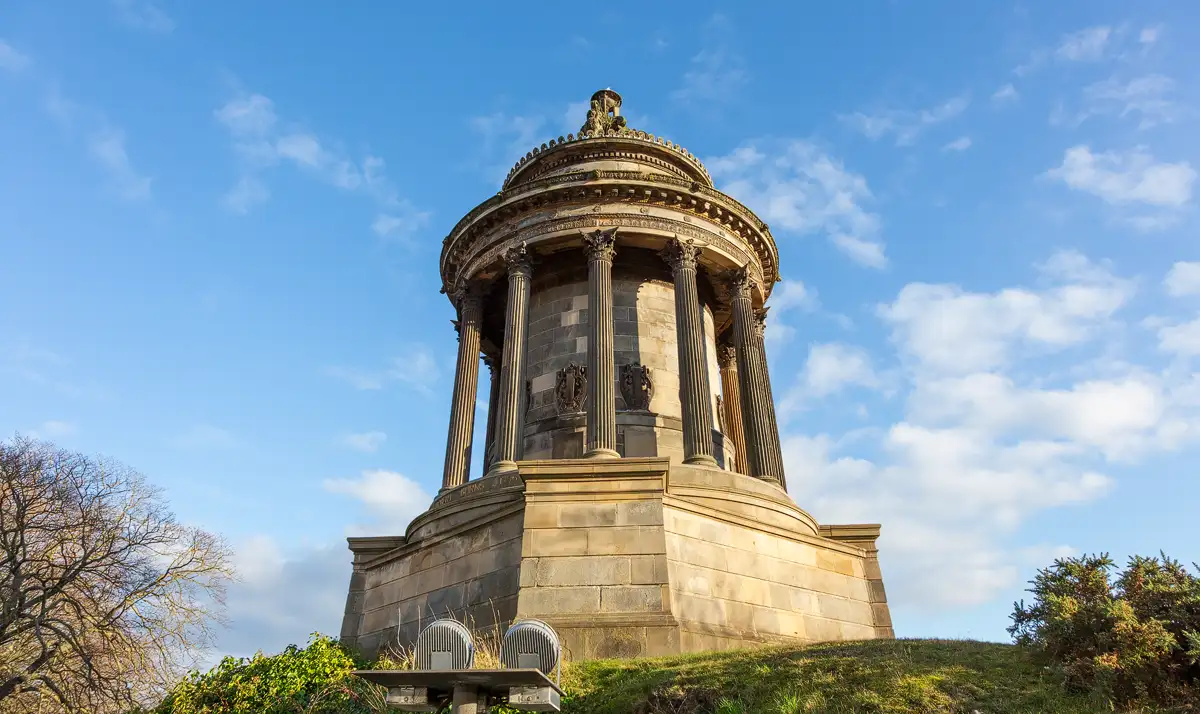
Even from outside, the monument is genuinely impressive. The craftsmanship in the stonework is extraordinary – the Corinthian column capitals are beautifully detailed, and the carved cornice with its rows of antefixae (ornamental blocks resembling palm leaves) gives the structure a real sense of classical grandeur. The griffon sculptures at the summit supporting the tripod are visible from below and add a dramatic silhouette against the sky.

Two interpretation panels are fixed to the railings, and they’re well worth reading. The first, a Calton Hill panel, explains the monument’s history, its connection to the Choragic Monument of Lysicrates, and provides a photograph of the original Flaxman statue now held in the Portrait Gallery. It also notes that the surrounding garden is planted with flowers mentioned in Burns’s poetry. The second panel is part of Edinburgh’s 101 Objects trail (#34), which describes the monument as a “pillared rotunda temple” and sets it in the context of Edinburgh’s Greek Revival architecture, noting how the city was keen to adopt all things Athenian as an expression of its advances in philosophy, science, and the arts.


The February afternoon light was wonderful for photography. The low sun lit up the sandstone beautifully, bringing out the warm tones in the stone and casting dramatic shadows through the columns. Janette and I spent a good while here just admiring the structure from different angles. The view from the monument itself is lovely – you look south across Canongate Kirkyard towards Holyrood Park and Arthur’s Seat, while behind you Calton Hill rises with its various monuments including the National Monument and Nelson’s Monument. Directly across Regent Road stands Thomas Hamilton’s other masterpiece, the Old Royal High School – an imposing Doric-columned building that makes for an impressive architectural pairing.
Frequently Asked Questions
Is the Burns Monument free to visit?
Yes, there is no charge to view the monument from the outside. The grounds are generally accessible, though the monument interior is usually locked. It is occasionally opened for special events such as Edinburgh’s Doors Open Days and Burns Night celebrations.
Can you go inside the Burns Monument?
The monument interior is generally not open to the public on a regular basis. However, the Edinburgh and District Burns Clubs Association hold events here, and the monument is sometimes opened during heritage events. The original marble statue that once stood inside can now be seen at the Scottish National Portrait Gallery on Queen Street.
Where is the Burns Monument in Edinburgh?
The monument is located at 1759 Regent Road, Edinburgh EH8 8DR, on the southern slope of Calton Hill. It’s roughly a 10–15 minute walk from Edinburgh Waverley station, heading east along Princes Street and continuing past Waterloo Place onto Regent Road.
Is there parking near the Burns Monument?
There is limited on-street parking on Regent Road, and a coach parking area directly in front of the monument. The nearest public car parks are at Greenside Row and New Street. However, given its central location, walking from the city centre or using public transport is often the easiest option.
Is the Burns Monument wheelchair accessible?
Access to the grounds involves a short gravel path on a gradient, and there are two steps into the monument itself (when open). The monument is not fully wheelchair accessible, though the exterior can be viewed from Regent Road without difficulty.
Are dogs allowed at the Burns Monument?
Dogs on leads are welcome in the grounds surrounding the monument.
How long does a visit take?
A visit to the Burns Monument typically takes around 15–20 minutes, though it pairs well with a walk up Calton Hill, which would extend your visit to an hour or more.
Key Information
- Location: 1759 Regent Road, Edinburgh EH8 8DR
- Grid Reference: NT 26519 74008
- Managed by: City of Edinburgh Council
- Entry: Free (exterior viewing; interior occasionally opened for events)
- Parking: Limited on-street parking on Regent Road; nearest car parks at Greenside Row and New Street
- Facilities: None on-site; nearest public facilities on the Royal Mile and at Waverley Station
- Accessibility: Gravel path on a gradient with two steps into the monument; not fully wheelchair accessible
- Dogs: Welcome on leads
What Else is Nearby?
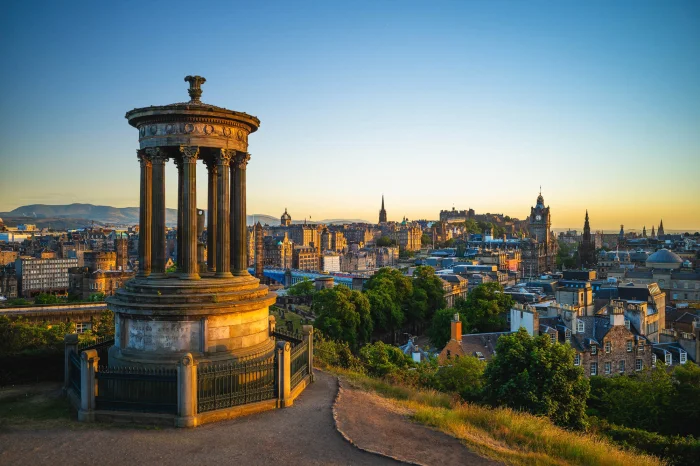
Calton Hill – Rising directly behind the Burns Monument, Calton Hill is one of Edinburgh’s most iconic viewpoints. The summit offers panoramic views across the city and is home to the National Monument, Nelson’s Monument, the Dugald Stewart Monument, and the City Observatory. It’s a short but steep walk from Regent Road.
The Old Royal High School – Directly across Regent Road from the Burns Monument, this magnificent Doric-columned building was designed by the same architect, Thomas Hamilton, and completed in 1829. It’s one of the finest examples of Greek Revival architecture in Britain.
Canongate Kirkyard – Just below the Burns Monument, this atmospheric kirkyard is the resting place of several notable figures, including economist Adam Smith, poet Robert Fergusson, and Agnes MacLehose (Burns’s ‘Clarinda’). An information board near the entrance lists the most notable burials.
The Palace of Holyroodhouse – A short walk further east along the Royal Mile, the official Scottish residence of the monarch sits at the foot of Arthur’s Seat. The palace offers guided tours through its state apartments and the ruins of Holyrood Abbey.
The Scottish National Portrait Gallery – If the Burns Monument whets your appetite, head to the Portrait Gallery on Queen Street to see the original white marble statue of Burns by John Flaxman that once stood inside the monument, along with Alexander Nasmyth’s famous 1787 portrait of the poet.
Final Thoughts
The Burns Monument is one of those Edinburgh gems that many visitors walk past without giving it a second glance, yet it’s a beautifully crafted tribute to Scotland’s greatest poet. The story of its creation – conceived by homesick Scots in Bombay, designed for free by the architect of the Royal High School across the road, and built to house a statue that had to be moved because Edinburgh’s gasworks were blackening the marble – is as rich and layered as any Burns poem. The connection to Clarinda in the kirkyard below only adds to the romance of the setting. If you’re walking along Regent Road or heading up Calton Hill, it’s well worth pausing here to appreciate one of the most refined pieces of Greek Revival architecture in Scotland.


Leave a comment below