
Scotland's National Poet and the Voice of a Nation
Robert Burns is the most celebrated figure in Scottish literary history. Born on 25 January 1759 in the village of Alloway in Ayrshire, he rose from a life of grinding rural poverty to become the national poet of Scotland - a status he has held unchallenged for more than two centuries. His poems and songs, written in both Scots and English, captured the full sweep of human experience with a wit, warmth and emotional honesty that transcended class, language and borders. He died at just 37 years of age, yet his influence on Scottish culture and identity remains immeasurable.
Early Life and Education
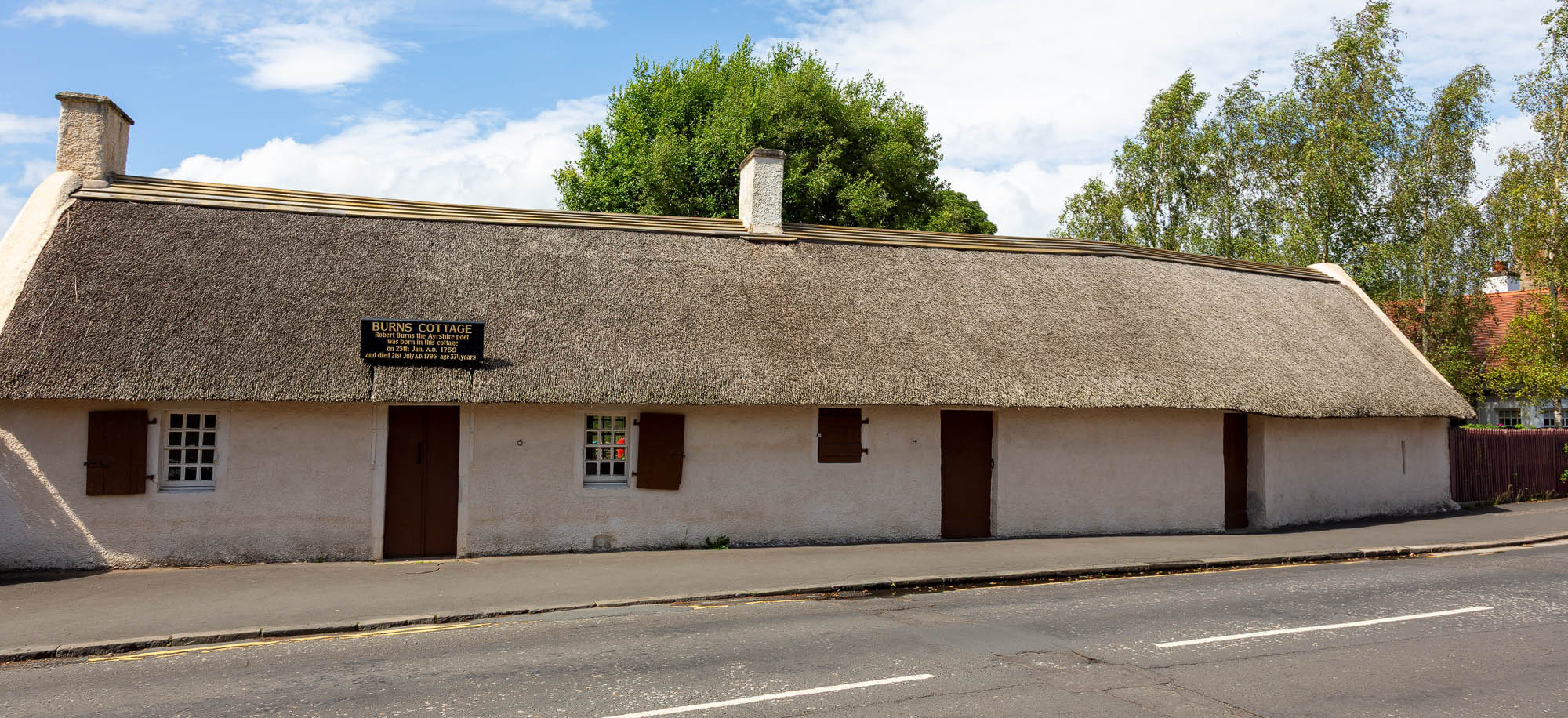
Burns was born in a small two-roomed cottage in Alloway that his father, William Burnes, had built with his own hands. William was originally from Kincardineshire in the north-east of Scotland and had come to Ayrshire hoping to improve his fortunes, working first as a gardener to the Provost of Ayr before turning to tenant farming. Burns's mother, Agnes Brown, was a local woman of farming stock who filled the household with traditional songs, stories and folklore - a wellspring of oral culture that would profoundly shape her eldest son's imagination.

Despite the family's modest circumstances, William Burnes was determined that his children would be educated. In 1765, he and several neighbours hired a young teacher named John Murdoch to open a small school in Alloway, where Robert and his younger brother Gilbert were taught reading, writing, arithmetic, French and Latin. When Murdoch left the parish in 1768, much of Robert's further education came directly from his father, who wrote a manual of Christian belief for his children's instruction. Burns was also a voracious reader, devouring whatever books he could lay his hands on, and absorbed huge quantities of traditional tales and songs from his mother and a kinswoman named Betty Davidson.
The family moved to the farm of Mount Oliphant in 1766, and by the age of fifteen Burns was the principal labourer on the holding. The relentless physical toil of farm work took a lasting toll on his health, but it also gave him a deep connection to the land, the seasons and the lives of ordinary working people - themes that would run through his finest poetry. It was during the harvest of 1774 that he fell in love for the first time, with a girl named Nelly Kirkpatrick who worked alongside him in the fields. She inspired his first attempt at verse, a song set to a traditional reel. From that moment, poetry and love would be the twin passions of his life.
Wine, Women and Song
In 1777 the family moved again, this time to the farm of Lochlea near Tarbolton. Here Burns threw himself into the social life of the area with characteristic energy. He co-founded the Tarbolton Bachelors' Club, a debating society, and became a Freemason. He also developed a reputation as an outspoken critic of the strict Calvinist wing of the church in Ayrshire, championing locals who fell foul of the kirk session for perceived moral failings.
In 1781 Burns went to work as a flax-dresser in Irvine, but the venture ended in spectacular fashion when an over-enthusiastic Hogmanay celebration by the staff resulted in the workshop catching fire and being destroyed. He returned to farming with his brother Gilbert, first at Lochlea and then, following their father's death in bankruptcy in February 1784, at the farm of Mossgiel near Mauchline. It was after William's death that the family changed the spelling of their surname from Burnes to Burns.
Burns pursued love with uncommon zeal. His relationships with women were numerous, overlapping and frequently scandalous. His first child, a daughter named Elizabeth, was born in 1785 to Elizabeth Paton, a servant at the family farm. He welcomed the child's arrival with a characteristically irreverent poem. Over the course of his life he fathered at least fourteen children by several different women. One biographer noted that it was not so much that Burns was conspicuously sinful as that he sinned conspicuously.
The Kilmarnock Edition
Between 1784 and 1786, Burns experienced an extraordinary burst of creative energy. Working at the plough by day and writing by candlelight in the evenings, he produced many of the poems that would make his name - including To a Mouse, To a Mountain Daisy, The Cotter's Saturday Night, The Holy Fair and Address to the Deil. These poems circulated locally in manuscript form and earned him a growing regional reputation.
On 31 July 1786, Burns published his first collection, Poems, Chiefly in the Scottish Dialect, printed at Kilmarnock by John Wilson. The Kilmarnock edition, as it became known, contained 612 copies and sold out within a month. It was a sensation. Burns had found his true voice in the Scots language, writing with words that came not from the classical dictionary but from the mouths of ordinary people. The collection brought together sharp social observation, tender emotion, biting satire and a deep love of the natural world in a way that Scottish literature had never quite seen before.
Prior to the book's publication, Burns had been seriously considering emigrating to Jamaica to work as a bookkeeper on a sugar plantation. The success of his poems, combined with the encouragement of influential supporters, persuaded him to stay. One of the women in his life at the time, Mary Campbell - known as Highland Mary - is said to have been left waiting for him at Greenock, though the full story of their relationship remains one of the great mysteries of Burns scholarship. Mary died shortly afterwards, possibly of typhus, and Burns mourned her deeply in several poems.
Edinburgh and Literary Fame
In November 1786 Burns arrived in Edinburgh, Scotland's cultural capital, and became the sensation of the season. Henry Mackenzie, writing in the influential literary periodical The Lounger, dubbed him a “heaven-taught ploughman” - a sentimental label that stuck, conjuring the romantic image of a rustic bard composing verses behind the plough. In reality Burns was a widely read and highly intelligent man, but the persona suited the literary tastes of the age and helped secure his celebrity.
Edinburgh's literary establishment welcomed Burns warmly, though he never found a permanent patron willing to support his writing full-time. He was, however, commissioned by the publisher James Johnson to assist in editing The Scots Musical Museum, a vast anthology of Scottish folk songs published in five volumes over sixteen years. Burns threw himself into the project with passion, contributing more than 150 of his own songs to the collection, reworking traditional material and composing new pieces. This labour of love, for which he received no payment, proved to be one of the most important acts of cultural preservation in Scottish history. Among the songs Burns contributed was his reworking of an older folk song into the version of Auld Lang Syne that would become an indispensable part of New Year celebrations around the world.
During his time in Edinburgh, Burns also sat for his most famous portrait, painted by Alexander Nasmyth in 1787. This image - showing Burns in a brown coat with his dark hair swept back - became the definitive likeness and the basis for almost every subsequent depiction of the poet.
Marriage, Dumfries and Tam o' Shanter
In 1788 Burns returned to Ayrshire and finally married Jean Armour, the woman who had been a constant through much of his adult life. Jean's father had previously torn up their marriage contract, outraged by Burns's reputation, but the couple were now formally wed. They settled at Ellisland Farm on the banks of the River Nith near Dumfries, and Burns also took up an appointment as an Excise Officer to supplement the family income.
The farm at Ellisland did not prosper, but Burns's pen was as sharp as ever. In 1790 he composed Tam o' Shanter, widely regarded as his greatest narrative poem and one of the finest works in the Scots language. The poem tells the story of a farmer who, riding home drunk from Ayr, stumbles upon a coven of witches dancing in Alloway's old kirkyard and must flee for his life across the Brig o' Doon. It is a masterpiece of pace, humour and supernatural atmosphere, immortalising the landscape of Burns's childhood.
Burns gave up farming entirely in 1791 and moved his family into Dumfries, where he worked full-time as an exciseman. Around this period he turned down both an offer of a position on the London-based Star newspaper and the chance to become Professor of Agriculture at the University of Edinburgh, choosing instead to remain in Scotland with his growing family.
Final Years and Death
During the 1790s Burns continued to write prolifically, contributing songs to both The Scots Musical Museum and George Thomson's A Select Collection of Original Scotish Airs. Works from this period include A Red, Red Rose, Scots Wha Hae and Ae Fond Kiss, each of which has become a cornerstone of Scottish song.
However, Burns's health was deteriorating, worsened by years of heavy drinking and the physical demands of his earlier life on the farm. His openly expressed support for the French Revolution and the principles of liberty and equality also damaged his reputation in some quarters, putting his position with the Excise at risk and alienating more conservative admirers.
In the summer of 1796, desperately ill, Burns travelled to Brow Well on the Solway Firth, where he hoped sea-bathing in the cold salt water would restore his health - a common but misguided medical remedy of the era. It did not help. Robert Burns died of rheumatic fever on 21 July 1796 in Dumfries, at the age of just 37. On the very same day, his wife Jean gave birth to their ninth child, a son named Maxwell. Burns was buried in St Michael's Churchyard in Dumfries, where a mausoleum was later erected in his honour.
Legacy and Celebration
Burns gained far more fame after his death than he ever achieved in his lifetime. His influence on the Romantic movement was profound - poets including William Wordsworth, Samuel Taylor Coleridge and Percy Bysshe Shelley all acknowledged their debt to him. His work also inspired novelists, songwriters and political thinkers far beyond Scotland. John Steinbeck took the title of his 1937 novel Of Mice and Men from a line in Burns's To a Mouse. Bob Dylan has cited Burns's A Red, Red Rose as the lyric that had the greatest effect on his life.
There are more statues and monuments dedicated to Robert Burns than to almost any other non-religious figure in history. They can be found not just in Dumfries, Kilmarnock, Aberdeen, Irvine and Glasgow, but as far afield as Montreal, Sydney, New York and Dunedin. The town of Burns in Allegany County, New York State, is named in his honour.

The first Burns Supper was held on 21 July 1801 when nine of his friends gathered at Burns Cottage in Alloway to mark the fifth anniversary of his death. The tradition was moved to his birthday, 25 January, and has continued ever since. Today, Burns Night is celebrated around the world with suppers featuring haggis, neeps and tatties, a recitation of Burns's Address to a Haggis, and toasts to the Immortal Memory of the poet. It is said to be the second most widely celebrated birthday event in the world.
In 2009, viewers of Scottish Television voted Burns “The Greatest Scot”, ahead of figures including William Wallace, Robert the Bruce and Alexander Fleming. For anyone wishing to explore Burns's world first-hand, the Robert Burns Birthplace Museum in Alloway is an outstanding starting point, housing original manuscripts, personal possessions and interactive displays that bring the poet's life and times vividly to life.

More than two centuries after his death, Robert Burns remains the heartbeat of Scottish culture. His words are sung at weddings and funerals, recited at Hogmanay gatherings and whispered over drams of whisky in pubs across the land. He gave Scotland its voice - and the world has been listening ever since.


