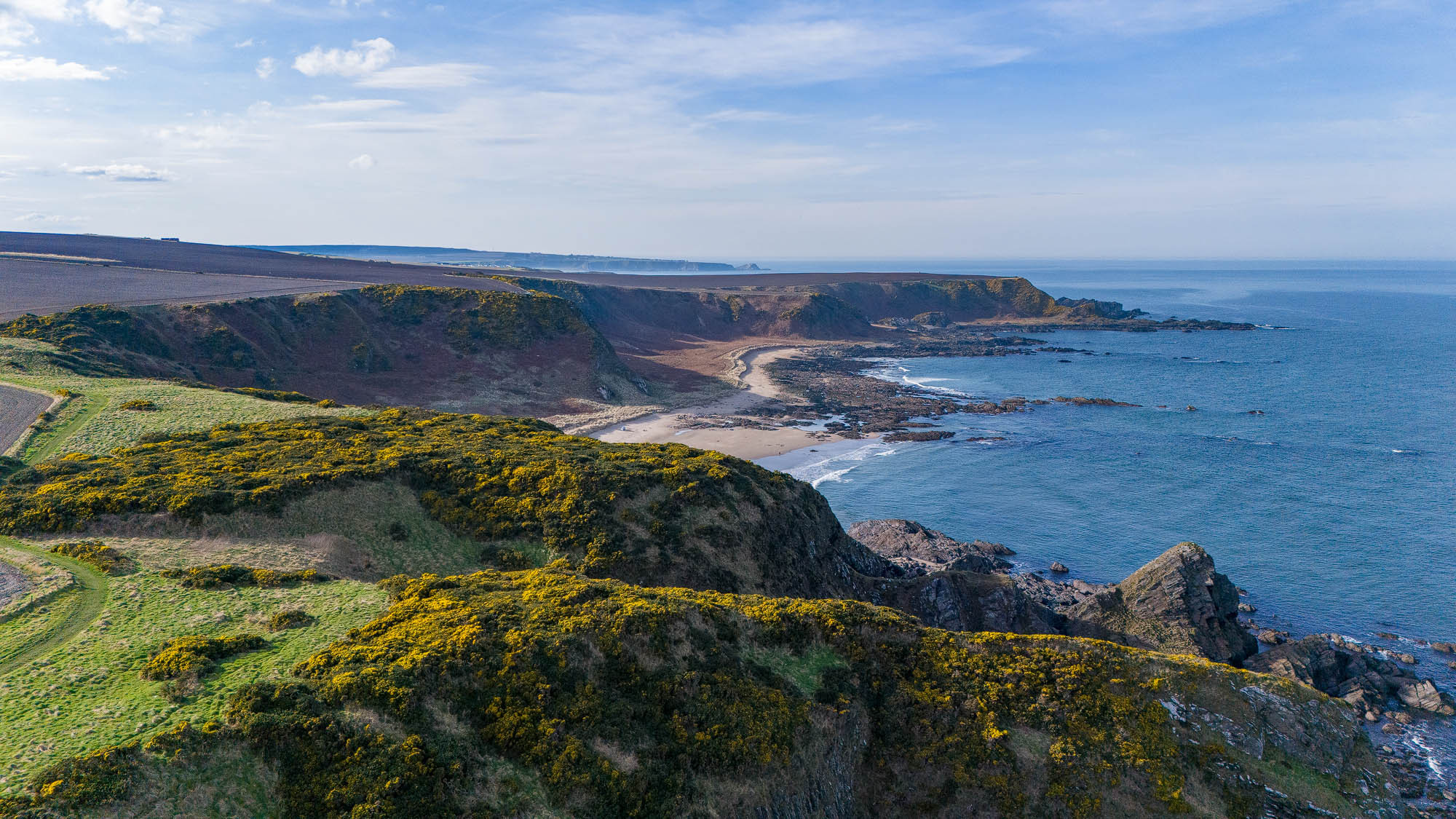
In the summer of 2025, Christopher Nolan brought the most expensive film of his career to the Moray coast - and it landed practically on our doorstep. Living just outside Buckie, I watched Viking-style longships tie up next to the RNLI lifeboat, saw security fencing go up around Findlater Castle and, like half of Buckie and Cullen, kept half an eye out for Matt Damon, who seemed to be everywhere.
That film was The Odyssey, Nolan’s retelling of Homer’s epic, released on 17 July 2026 with Matt Damon as Odysseus. It was shot almost entirely on real locations across six countries, and the north-east of Scotland gave it some of its strangest and most memorable scenery: a ruined clifftop castle, a tucked-away beach, a forest planted on top of a buried estate and a pair of working harbours.
This guide covers every Scottish filming location we know about, which scene each one appears in, what was going on locally while the cameras were rolling, and how to visit the places yourself. It includes our own photographs, including drone shots of the sets and the film boats taken during the shoot, so you can see how things looked before the crews packed up and the grass grew back.
Spoiler note: this article mentions which parts of the story were filmed where. If you haven’t seen the film yet, the broad outline follows Homer, but a few details are Nolan’s own.
The Odyssey Filming Locations in Scotland at a Glance
| Location | What happens there in the film | Can you visit? |
|---|---|---|
| Culbin Sands and Culbin Forest, near Forres (Moray) | Odysseus and his crew land and are attacked by the armoured, giant Laestrygonians | Yes - forest trails from Forestry and Land Scotland car parks, but the beach is a long walk |
| Sunnyside Beach, near Cullen (Aberdeenshire) | Odysseus comes ashore on Circe’s island and hunts a deer | Yes - on foot only, via a steep path |
| Findlater Castle, between Cullen and Sandend (Aberdeenshire) | Aeaea, the island home of the sorceress Circe | Yes - viewpoint only, the ruins themselves are unsafe |
| Buckie Harbour (Moray) | Base for the film’s fleet, including the longship that plays Odysseus’s vessel | Yes - a working harbour, free to wander |
| Burghead Harbour (Moray) | Launch point where cast boarded boats to reach locations along the coast | Yes - with the Pictish fort right next door |
Here’s a detail I haven’t seen mentioned anywhere else: if you visit the three main filming locations from west to east - Culbin, then Sunnyside, then Findlater - you follow the same order as the story. In Homer’s poem, Odysseus barely escapes the Laestrygonians and then sails on to Circe’s island, which is exactly the sequence the film shot along roughly 40 miles of the Moray Firth coast.

About the Film
The Odyssey was written and directed by Christopher Nolan and produced with Emma Thomas through their company, Syncopy, for Universal Pictures. Matt Damon leads as Odysseus, the king of Ithaca trying to get home after the Trojan War, with Tom Holland as his son Telemachus, Anne Hathaway as Penelope, Zendaya as Athena, Robert Pattinson as the suitor Antinous, Lupita Nyong’o as Helen, Charlize Theron as Calypso, Jon Bernthal as Menelaus and Samantha Morton as Circe.
Filming started in Morocco in February 2025 and moved through Greece, Sicily and the Aeolian Islands, Malta, Iceland and Scotland, with the Moray coast shoot taking place in June and July 2025. Nolan shot the film using IMAX film cameras and leaned heavily on real locations, real ships and in-camera effects rather than green screens. The production was reported to have cost around $250 million, making it the most expensive film of his career.
It paid off. The world premiere was held in Leicester Square on 6 July 2026, the film opened on 17 July to the biggest global launch of Nolan’s career, and within a few weeks it had passed $1 billion at the worldwide box office. Which means millions of people around the world have now watched the Moray coast pretending to be ancient Greece - most of them without the faintest idea where it is.
Why Did Christopher Nolan Film The Odyssey in Scotland?
It seems an odd choice at first. Homer’s world is all wine-dark seas and sun-baked islands, so why bring a Greek epic to a firth that can feel like November in the middle of July?
I think the answer is that the wandering part of the Odyssey was never meant to feel like home. Odysseus is lost in a strange, hostile world full of monsters and magic. The Moray coast gave Nolan a different texture from the bright Mediterranean scenes: grey quartzite cliffs, pine forests growing out of sand dunes, cold shingle beaches and a sea that rarely sits still. Circe’s island in particular needed to feel eerie and other-worldly, and Findlater on an overcast day does that very well indeed.
There were practical reasons too. The coast offers huge variety within an hour’s drive, with harbours at Buckie and Burghead that could handle the film’s boats and crew. Screen Scotland’s Screen Commission also worked with the production to make sure Scotland was used as a filming location, and Moray Council’s film liaison service has since published official maps of the sites for visitors.
Findlater Castle - Circe’s Island of Aeaea
Findlater Castle was the main Scottish filming location and the one that got the most attention. Its ruins sit on a narrow quartzite promontory roughly 50 feet above the Moray Firth, surrounded by water on three sides, between Cullen and Sandend. In the film it becomes Aeaea, the island home of Circe, the sorceress who turns Odysseus’s crew into pigs.
The site was closed to the public from 27 May to 25 July 2025, and the coastal paths from Cullen to Sandend were diverted around it. A planning notice described the construction, lighting and dressing of two film sets, and that’s exactly what we saw from the air: a stone-effect building rising out of the grassy slope above the castle, a long green screening fence along the clifftop, a crew compound full of vans and equipment, lighting platforms dotted across the hillside and a temporary roadway laid straight across the farmer’s field. Moray Council’s own location notes describe a scene of Matt Damon inside a building with the castle as a backdrop, which matches that set.

Nolan’s version of Circe is a darker, sadder figure than the one many of us remember from school, and Samantha Morton’s transformation scene is one of the most unsettling moments in the whole film. The first trailer, released in December 2025, also included a shot of soldiers running from a clifftop down towards the sea that looks very much like Findlater.

A Real History as Dramatic as the Myth
Findlater doesn’t need Hollywood to make it interesting. A fortress has stood here since at least the 13th century, and it is said to have been attacked by Norwegian forces in the 13th century. Most of what survives today dates from the 15th century, when it belonged to the Ogilvies, later the Earls of Findlater and Seafield. The name is thought to mean “white cliff”, a nod to the pale quartzite beneath it.
In 1562, the castle was at the centre of a family feud that pulled in Mary, Queen of Scots herself, when Sir John Gordon seized it and refused to give it up. By the early 1600s the Ogilvies had moved to the far more comfortable Cullen House, and Findlater was left to the wind. You can read more about its history, ghost stories and the nearby doocot in our full Findlater Castle guide.


Visiting Findlater Castle
Findlater is signposted off the A98 between Cullen and Portsoy. There’s free informal parking at Barnyards of Findlater farm, then a walk of around 500 metres on a rough track to a circular stone viewpoint with an information board and a bench. From here you get the classic view of the castle on its promontory.
Please don’t try to get into the ruins. The structure is unstable, the approach is a narrow, crumbling neck of rock and the drops on either side are sheer. The viewpoint, and the coastal path in either direction, give you everything you need. If you want a longer outing, the Moray Coast Trail runs from Cullen past Sunnyside and Findlater to Sandend and Portsoy.

Sunnyside Beach - Odysseus Washes Ashore
Just west of Findlater, tucked beneath the cliffs on the way back towards Cullen, is Sunnyside Beach. It’s a lovely, secluded spot, partly because you have to work to get there: there’s no road, just a path down a steep, grassy slope.
In the film, this is where Odysseus comes ashore before the Circe sequence begins. Videos taken during filming showed the sand dressed with the wreckage of Greek ships. Shortly after landing, Odysseus kills a deer on the grass near the beach - and in one of Nolan’s more chilling twists, it turns back into a man as it dies, a first hint of what Circe does to anyone who lands on her island.
That moment has its roots in Homer. In Book 10 of the poem, Odysseus kills a huge stag near Circe’s island and carries it back to feed his exhausted crew. Nolan’s version takes that small detail and turns it into a warning, which I thought was a clever bit of adaptation.

Moray Council’s visitor guide also points out a neat coincidence here. The rocks off Sunnyside are the site of the wreck of the Artemis, a 20th-century ship whose crew all survived. Artemis was, of course, the Greek goddess of the hunt - an oddly fitting name for the beach where Odysseus makes his kill.
Visiting Sunnyside Beach
Sunnyside is reached on foot along the clifftop path, either from the Findlater viewpoint (around 10 to 15 minutes’ walk west) or from Cullen along the coastal path. The descent to the sand is narrow and steep and gets slippery after rain, so wear proper footwear and take care with children and dogs. Once you’re down, it’s a quiet, sheltered cove of golden sand, folded rock and rock pools, and you’ll often have it to yourself.

Culbin Sands and Culbin Forest - The Land of the Laestrygonians
About an hour’s drive west, between Nairn and Forres, the film found a completely different landscape. Culbin is one of the largest coastal dune systems in Britain, now mostly covered in pine forest, and it played host to one of the film’s most brutal sequences: Odysseus and his crew landing on the beach at Culbin Sands, then being ambushed by the Laestrygonians in the forest beyond.
In Homer, the Laestrygonians are giant cannibals who hurl boulders down on Odysseus’s fleet and destroy every ship except his own. Nolan reimagined them as towering warriors in metallic silver armour, and rather than shrinking or enlarging actors digitally, the giants were created in camera using forced perspective and wirework. The armoured attack on the beach was filmed on Culbin Sands, and the chase into the trees was filmed in the forest itself.
While the crew were working, Forestry and Land Scotland restricted access to the Buckie Loch area of the beach and forest edge until 25 July 2025, and the Wellhill car park was closed from 3 to 16 July. (That’s Buckie Loch near Culbin, by the way - nothing to do with Buckie the town.)

A Forest With Its Own Legend
Culbin’s real history is every bit as mythical as anything Nolan put on screen. In 1694, a great sand storm buried the Barony of Culbin, a wealthy estate of farms, orchards and a mansion house, almost overnight. Sixteen farms were lost under the dunes.
Locals connected the disaster to Isobel Gowdie, the woman from nearby Auldearn whose remarkable witchcraft confessions in 1662 are among the most detailed in Scottish history. She was said to have talked of a farm at Culbin being smothered in sand, and when the storm came three decades later, many saw it as a curse fulfilled.
The shifting sands kept moving until the Forestry Commission began planting in the 1920s to stabilise them. During the Second World War, the area was used for training ahead of the D-Day landings. Today the forest is a Site of Special Scientific Interest, home to more than 500 species of flowering plants along with crested tits, red squirrels and roe deer. A land that was swallowed by a curse and then attacked by giants - you couldn’t make it up, although Homer and Nolan had a good go.
Visiting Culbin
The easiest way in is from the Wellhill car park near Kintessack, outside Forres, which has toilets and a parking charge. From there, the Hill 99 trail takes you up to the wooden viewing tower, which gives you a view over the treetops to the sands and the Moray Firth beyond. It’s the best way to get a sense of the landscape the film used without committing to the full trek.
Reaching the actual beach is a different matter. The sands are much further than they look from the tower, past Buckie Loch where the trees give way to marram dunes, and the round trip is several miles over forest tracks and soft sand. Check the tide times, take water and allow plenty of time.

Buckie Harbour - Home Port for Odysseus’s Fleet
For those of us who live around Buckie, this was where the shoot felt most real. Moray Council has confirmed that both Buckie and Burghead harbours were used for logistics support, and for a few weeks in the summer of 2025 Buckie Harbour was home to the most unusual fleet it has ever seen. The production reportedly even rented an office in town from the council.
The star was the Draken Harald Hårfagre, a 35-metre (around 115-foot) wooden longship built in Norway as an experimental archaeology project to test how large Viking ships actually performed at sea. She has crossed the North Atlantic, sailed the Great Lakes and is the largest Viking ship built in modern times. In The Odyssey, she plays Odysseus’s own ship, and she also spent months filming around the Greek and Italian islands and in Iceland.

The Draken was kept well away from prying eyes. Screening went up along the quay where she was moored and a security guard kept people back, so getting a decent look at her from the ground was close to impossible. The drone was a different story.


The smaller boats were a different story. Two wooden, Norse-style longboats were moored in the inner harbour, right alongside the orange RNLI lifeboat, and anyone could walk up and look at them. Up close you could see the bundled oars, furled red sails, rope rigging and the carved fittings on their stems - plus the occasional modern outboard motor tucked discreetly at the stern. Seeing them next to a lifeboat and a row of fishing boats was one of the more surreal sights of the summer.


You might wonder why a story set in the Bronze Age uses ships whose design dates from the Viking Age, nearly two thousand years later. The short answer is that very few large, seaworthy ancient ships exist, and Nolan wanted real vessels in real seas rather than models in a tank. A properly built Norse longship, crewed by people who know how to sail one, gets you much closer to the look and feel of an ancient Greek galley than anything else afloat.

Burghead Harbour - The Launch Point
Further west, the small harbour at Burghead was used as a jumping-off point for filming at sea and along the coast. Tom Holland was photographed boarding a fast boat here during the shoot, heading out to a location further along the coast, and Matt Damon and Zendaya were also seen boarding boats in the harbour. Burghead sits between Culbin and Buckie, which made it a sensible base for reaching the Culbin shoot by sea.
Burghead doesn’t appear on screen as itself, but it’s well worth a visit if you’re following the trail. The village is built on top of what was once the largest Pictish fort in Scotland, and the mysterious Burghead Well, the fort ramparts and the visitor centre are a few minutes’ walk from the harbour.

Hollywood on the Moray Coast - The Summer of 2025
It’s hard to overstate the buzz along this stretch of coast in June and July 2025. Buckie, Cullen, Portknockie, Sandend and Portsoy were full of rumours, and for once most of them turned out to be true.
Matt Damon was the most visible of the cast, and by all accounts one of the friendliest. He was a regular at Motion Fitness gym in Buckie, where he happily posed for photos with other gym-goers, and he was presented with a Buckie Thistle FC shirt, which he signed for the club. In Cullen he browsed the Cullen Antiques Centre and seemed to visit just about every shop on the main street. One local shopkeeper said he had time for everybody, and he described Cullen as “wonderful”. He was even spotted at a go-karting track near Lhanbryde.

Damon stayed at the Seafield Arms Hotel in Cullen, an 1822 coaching inn on Seafield Street. The hotel was busy with cast and crew throughout the shoot: its ballroom was turned into a private screening room and other rooms became editing suites. The managing director later shared that Damon had called it the best dining experience the cast had come across on their travels around the world - quite a compliment, considering where else they’d been filming. The shoot has since been credited with inspiring a major new investment in the hotel.
He wasn’t on his own, either. Damon brought his family along and later told the Sunday Mail that he’d turned the Scottish shoot into a family holiday, and that he’d been bowled over by how beautiful Cullen was. Jon Bernthal, who plays Menelaus, was also seen around Cullen with him. My brother Matthew had a memorable moment of his own when he met both of them outside his house on Grant Street, as Damon and his family set off up Castle Hill to take in the view over the town and the viaduct. Not the sort of thing that normally happens on an ordinary day in Cullen.
Further afield, Tom Holland and Zendaya were spotted in Inverness before heading to the Moray filming locations, and the Draken was photographed sailing under the Kessock Bridge.
Planning Your Own Odyssey Trail Along the Moray Coast
All of the Scottish filming locations sit within about 40 miles of each other, so you can see the lot in a single long day, although two days is more relaxing. If you want to follow the story in order, start at Culbin and work east:
- Morning - Culbin Forest: walk the Hill 99 trail from the Wellhill car park and climb the viewing tower for a look over the forest and sands where the Laestrygonians attacked. Allow two hours, or most of the day if you want to reach the beach.
- Lunch - Burghead: stop at the harbour where the cast boarded their boats, and walk up to the Pictish fort and Burghead Well.
- Afternoon - Buckie: wander along the harbour where the film’s fleet was based. Our guide to Buckie has more on the town.
- Late afternoon - Cullen and Findlater: follow Damon’s lead up Castle Hill, have a bowl of Cullen skink, then drive or walk to the Findlater viewpoint and down to Sunnyside Beach.
For walkers, Moray Council has also published an Odyssey Trail along the coastal path from Cullen to Portsoy. It’s about seven miles one way and takes in Sunnyside Bay, Findlater Castle, Sandend Beach and Portsoy Harbour. Look out for bottlenose dolphins, seals and seabirds along the way.
A few practical points. The clifftop paths are unfenced and the ground can be uneven, so keep dogs on leads near the edges. Respect the farmland, park considerately at Barnyards of Findlater, and follow the Scottish Outdoor Access Code. And if you’re flying a drone, remember that Findlater is a fragile, protected archaeological site and that the cliffs are busy with nesting seabirds in spring and early summer.
More Places to Explore Near The Odyssey Filming Locations
The Moray coast has plenty to offer beyond the film sites, and several of these are within a few miles of where the cameras were rolling:
- Bow Fiddle Rock, Portknockie - a spectacular sea arch just west of Cullen, and arguably the most photographed rock on the coast.
- Sandend - a small fishing village with a sweeping sandy bay, just east of Findlater and the next stop on the coastal path.
- Bin of Cullen - climb the hill behind Cullen for a panoramic view across the whole stretch of coast where the film was shot.
- Cullen to Portknockie caves walk - a coastal walk past sea caves and stacks that wouldn’t look out of place in an ancient epic either.
- Spey Bay - home to the Scottish Dolphin Centre and the historic Tugnet Ice House, and a great place to spot the Moray Firth’s famous dolphins.
- Brodie Castle - a short drive from Culbin, with gardens famous for their daffodils and a fine collection inside.
If you’re a film fan, you might also enjoy our round-up of Scottish films and our guide to Outlander filming locations.
Videos of The Odyssey Boats in Buckie Harbour
FAQs on The Odyssey Filming Locations in Scotland
Where was The Odyssey filmed in Scotland?
Christopher Nolan filmed The Odyssey on the Moray coast in north-east Scotland in June and July 2025. The main filming locations were Findlater Castle and Sunnyside Beach near Cullen in Aberdeenshire, and Culbin Sands and Culbin Forest near Forres in Moray. Buckie and Burghead harbours were used as bases for the film’s boats and crew.
Which scenes in The Odyssey were filmed at Findlater Castle?
Findlater Castle stands in for Aeaea, the island home of the sorceress Circe, played by Samantha Morton. A film set was built on the slope above the ruins, and the castle and its clifftops form the backdrop to the Circe sequence, in which Odysseus’s crew are turned into pigs.
Where was the Laestrygonian attack in The Odyssey filmed?
The scenes where Odysseus and his crew land and are attacked by the giant, armoured Laestrygonians were filmed on Culbin Sands and in Culbin Forest, between Nairn and Forres in Moray. The giants were created in camera using forced perspective and wirework rather than CGI.
What ship was used as Odysseus’s ship in The Odyssey?
Odysseus’s ship is played by the Draken Harald Hårfagre, a 35-metre wooden longship built in Norway and the largest Viking ship built in modern times. It was moored in Buckie Harbour during the Scottish shoot, alongside smaller Norse-style longboats.
Where did Matt Damon stay while filming The Odyssey in Scotland?
Matt Damon stayed at the Seafield Arms Hotel in Cullen, which hosted cast and crew during the shoot. He was regularly seen around Cullen and Buckie with his family, including at Motion Fitness gym in Buckie, and co-star Jon Bernthal was also seen with him in Cullen.
Can you visit The Odyssey filming locations in Scotland?
Yes. Findlater Castle can be seen from a viewpoint about 500 metres from parking at Barnyards of Findlater, although the ruins themselves are unsafe to enter. Sunnyside Beach is reached on foot via a steep clifftop path, and Culbin Forest has waymarked trails from Forestry and Land Scotland car parks. Buckie and Burghead are open working harbours.
When was The Odyssey filmed in Scotland and when was it released?
Filming on the Moray coast took place in June and July 2025, with Findlater Castle closed to the public from 27 May to 25 July 2025. The Odyssey was released in cinemas on 17 July 2026.
Final Thoughts
Film tourism tends to make places feel borrowed - as if their main claim to fame is having briefly been somewhere else. I don’t think that’s the case here. Findlater was a stronghold long before it was Circe’s lair, Culbin had its own legend of a buried estate and a witch’s curse three centuries before the Laestrygonians showed up, and Buckie has been launching boats into rough water for generations.
What Nolan did was notice what those of us who live here already knew: that this coast has a wild, slightly otherworldly quality that suits an ancient story. The sets have gone, the fences are down and the grass has grown back over the temporary roadway at Findlater. But the next time someone in Sydney or Seoul watches Odysseus stagger up a Scottish beach, I’ll be quietly pleased that it’s Sunnyside - and that you can still walk down there and have it to yourself on a good day.
All information was correct at the time of writing, please check things like entry costs and opening times before you arrive.

Leave a comment below