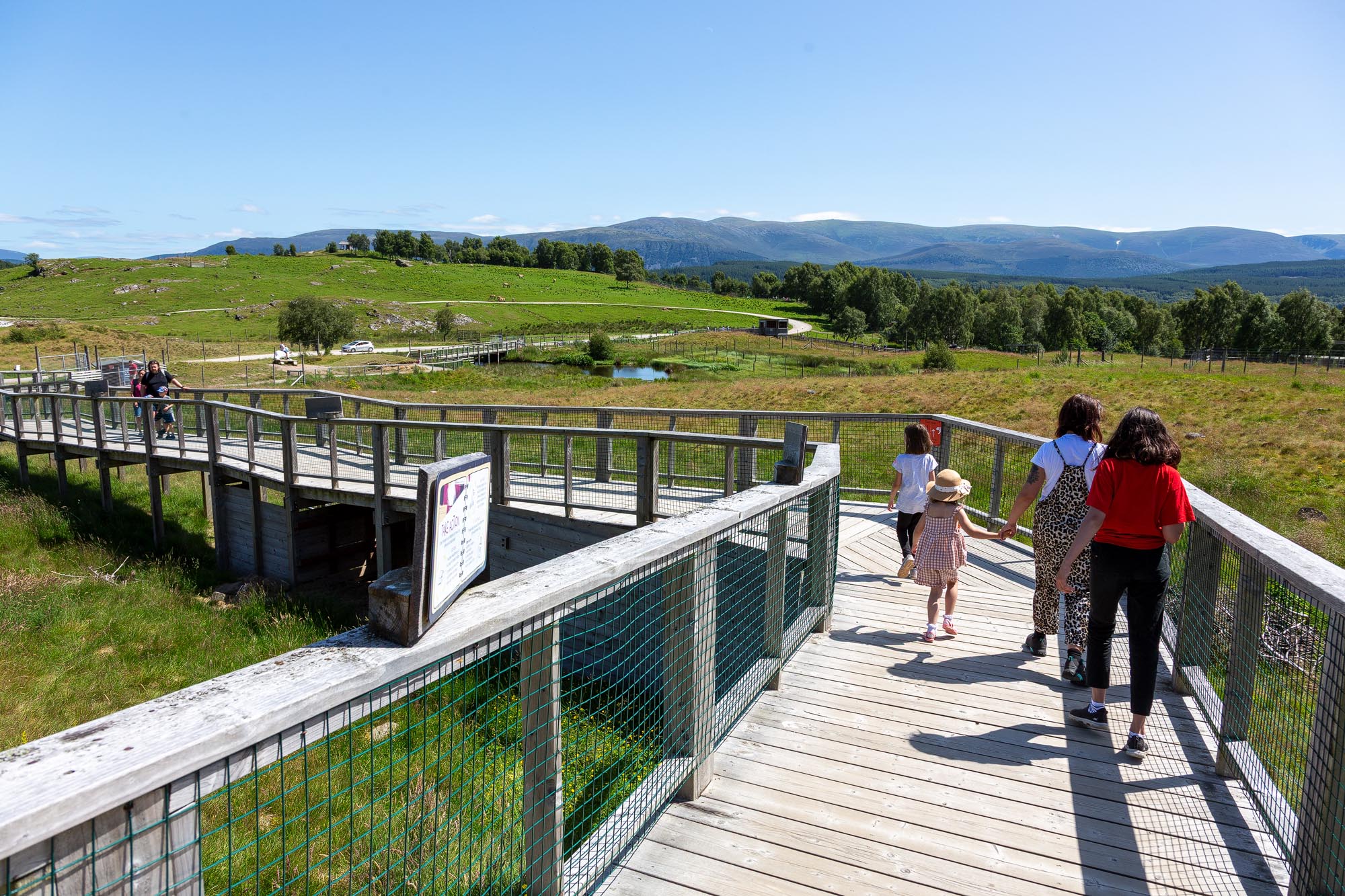
It was a roasting hot day in July 2025, and Janette, the girls and I were staying in Aviemore for our summer week in the Cairngorms. With blue skies overhead and far too much sunshine for Scotland, we decided to head out to Highland Wildlife Park near Kincraig. The kids were excited about the polar bears (still very much the main event for our youngest, Lauren), Janette wanted to see the snow leopards, and I was keen to try my luck with the Amur tigers. This wasn’t our first visit – we’ve been back several times over the years – and I’m happy to say the park keeps getting better.
Highland Wildlife Park sits seven miles south of Aviemore in the heart of the Cairngorms National Park, and it’s one of the most unusual wildlife attractions in Scotland. Run by the Royal Zoological Society of Scotland (RZSS) – the same charity that operates Edinburgh Zoo – it’s home to over 200 animals representing cold-climate species from around the world, alongside native Scottish wildlife. The real draw, though, is that it’s not really a zoo in the traditional sense. Half of the 260-acre site is a drive-through safari reserve, which means you experience elk, bison, deer and camels from the comfort of your own car before parking up and walking the rest of the site on foot.

Contents
- A Brief History of Highland Wildlife Park
- The Two Halves – Walking Area & Main Reserve
- Our Visit to Highland Wildlife Park
- Scotland’s Wildlife Discovery Centre
- The Main Reserve Drive-Through
- The Royal Zoological Society of Scotland
- Daily Talks, Feeding Times & Events
- Practical Visitor Information
- Frequently Asked Questions
- Key Information
- What Else is Nearby?
- Conclusion
A Brief History of Highland Wildlife Park
Highland Wildlife Park opened to the public in 1972, and the park you’ll visit today is very different from the one that first welcomed visitors five decades ago. In its early years, the mission was to showcase native Scottish species – wolves, wildcats, red foxes, pine martens, polecats, Highland cattle, Soay sheep and red deer among them – giving visitors a sense of the kind of wildlife that had once roamed the Scottish Highlands.
In 1986, the park was taken over by the Royal Zoological Society of Scotland, the charity that has also run Edinburgh Zoo since 1913. For the next two decades, the focus on native Scottish species continued, and the park picked up one of the stranger stories in Scottish wildlife history along the way. In 1980 a puma was reportedly captured nearby by a local farmer, Ted Noble, and given to the park. She was named Felicity and became a minor celebrity before living out her days at Kincraig. Her taxidermied body is now on display at Inverness Museum and Art Gallery – the kids have since seen her there.
The biggest change came in 2007, when RZSS repositioned the park around the theme of cold-climate species from mountain and tundra habitats worldwide. Bharal, markhor, yak, Japanese macaques, kiang, Bactrian deer, Mishmi takin, red pandas, Himalayan tahr, European elk and Amur tigers all arrived between 2007 and 2010. The shift was controversial at the time – some locals felt it distanced the park from its original purpose – but it dovetailed with RZSS’s global conservation work and proved to be a much stronger draw for visitors.
Polar bears arrived in 2009, when Mercedes – the last polar bear at Edinburgh Zoo – was moved to a new purpose-built enclosure in the Highlands to live out her retirement. Walker followed in 2010, Arktos in 2012, and Victoria in 2015. Today the park is a member of both the British and Irish Association of Zoos and Aquariums (BIAZA) and the European Association of Zoos and Aquaria (EAZA), and plays a central role in international breeding programmes for species like the Scottish wildcat, the Amur tiger, the snow leopard and the polar bear.
The Two Halves – Walking Area & Main Reserve
Before I walk you through our visit, it helps to understand that Highland Wildlife Park is essentially two attractions in one.
The walking area, centred around the visitor centre and car parks, is where you’ll find most of the individual species enclosures – snow monkeys, tigers, polar bears, snow leopards, wildcats, red pandas, wolves and so on. This is where you’ll spend the bulk of your visit. Allow around two hours at a brisk pace, longer if you linger at every enclosure (as our girls always do).
The main reserve is the drive-through safari section, a winding loop road through large open enclosures where hoofed species live in herds and mixed groups – Bactrian camels, yak, elk, red deer, vicuñas, European bison, Bactrian deer, Przewalski’s horses, musk oxen and Mishmi takins. You can drive it as many times as you like with a single day’s ticket, and you’ll want to – these are some of the most impressive animals in the park, and the light changes what you can see.
Our Visit to Highland Wildlife Park
Getting There & Arrival
Highland Wildlife Park is easy enough to reach in theory, but a little frustrating in practice if you trust your sat-nav blindly. The postcode is PH21 1NL but GPS can be unreliable around Kincraig, and plenty of visitors have ended up on farm tracks. The simplest advice is to stay on the A9 until you see the brown tourism signs for Highland Wildlife Park – turning off either between Aviemore and Kingussie, or south of Aviemore – and then follow the B9152 (the old A9) through Kincraig. The park entrance is clearly signed on your right.

We drove down from Aviemore on a warm Thursday morning and arrived at about 11.30am. Staff at the gate kiosk waved us through towards the “monkey field car park” – the main visitor car park, a short walk from the visitor centre. Parking is free, which is always a welcome surprise at a big attraction.
Because it was already lunchtime and the girls were hungry, we decided to eat first at the adventure playground, which has a scatter of picnic tables in a shaded area. The play park itself is genuinely excellent – a big timber climbing frame with slides, a proper rope net and plenty of space to run off some energy. Olivia, in particular, was reluctant to leave, and we had to top her sunscreen up twice before we could coax her away. Ellie, being the oldest, was already itching to get moving and see the animals.
Snow Monkeys
We started our loop of the walking area at the Japanese macaque enclosure, which is set up cleverly with a large pool and a climbing frame visible through tall plexiglass panels. Snow monkeys (as they’re known, thanks to the Japanese highland populations that famously bathe in hot springs) are incredibly expressive animals, and there were at least two juveniles tumbling around on the ropes while the adults sat grooming and watching us with the weary resignation of parents everywhere.

Lauren, who’s the youngest of our three, pressed her face right up to the glass to pull faces at them. One of the younger macaques obliged by pulling an equally dramatic face back. I’m not sure who enjoyed the exchange more.

Amur Tigers
From the macaques we headed round to the Amur tigers – the largest tigers in the world and a species I’ve been fascinated with since I was a kid. Sadly, timing wasn’t on our side this visit; the tigers were nowhere to be seen when we arrived, which is one of the realities of a wildlife park rather than a traditional zoo. Animals have their own lives to lead.

The tip worth remembering is that the tigers are fed at around 2.30pm, and that’s usually the best time to see them close to the front of the enclosure. On an earlier visit, we timed it right and watched a proper keeper talk at feeding time – the kids were fascinated, and you really appreciate the size of these animals when they come down to the viewing gallery. The photo above is from that earlier trip.
The Polar Bears – Past & Present
The polar bears are, for most visitors, the headline draw of Highland Wildlife Park – and rightly so. These are Scotland’s only polar bears, and the enclosures (around ten acres dedicated to polar bears across the walking area and a separate habitat on the western side of the site) are among the largest and most thoughtfully designed in any European zoo.
On this visit we got to see both Arktos, who was born at Tiergarten Schönbrunn in Vienna in November 2007 and arrived at the park in 2012, and Walker, who was born at Ouwehands Zoo in the Netherlands in December 2008 and arrived in 2010. They are fast friends who share a custom-built enclosure and spend much of their time swimming, wrestling and, in the heat of a Scottish July afternoon, sprawled out by the water feature looking thoroughly unimpressed with the sunshine. They are magnificent animals – bigger than you expect, even when you know how big they are.

The third polar bear at the park on our visit was Brodie, Victoria’s younger cub, born in December 2021. Brodie is the little brother of Hamish, the first polar bear cub born in the UK for twenty-five years when he arrived in December 2017. Hamish moved to Yorkshire Wildlife Park in October 2020, and for years the two brothers had never met. Towards the end of 2025 the park announced that Brodie would also be making the trip south – on a temporary basis – while his enclosure at Kincraig undergoes upgrade work, meaning the two brothers would finally be introduced. If you’re visiting from early December 2025 onwards, you may not see Brodie in Scotland; check the RZSS website for the latest.

The photograph above is of Victoria, Brodie and Hamish’s mother, who was the matriarch of the polar bears at the park for a decade. Victoria was born at Rostock Zoo in Germany in December 1996 and came to Kincraig in March 2015 from Aalborg Zoo in Denmark. She raised three cubs over her life, including Hamish and Brodie here in Scotland. Sadly, Victoria passed away on 20 May 2025 at the age of 28 – she was the UK’s oldest polar bear and had been receiving geriatric care for some time. We’ve visited the park enough times over the years that all three of our girls met Victoria at some point, and the female enclosure felt noticeably different without her on this visit. Her legacy lives on through her cubs, and through the hundreds of thousands of visitors who learned about the climate threats facing polar bears in the wild because of her. She was a very special animal.
Arctic Foxes
Back on the main circular walk, the Arctic fox enclosure is a short distance from the polar bears. These little white-coated foxes are adorable when they’re visible, and they’re also experts at hiding – there’s a fair amount of vegetation for them to disappear into. We didn’t spot the foxes this time, but Janette reminded me that we saw them curled up asleep on a cold April visit a few years back. The picture below is from that trip.

Just past the Arctic foxes there’s an excellent elevated viewpoint looking out over the main drive-through reserve, which is well worth a pause – it’s one of the best photograph spots in the park.

Markhor, Musk Oxen & Vicuñas
Between the polar bears and the snow leopards there’s a stretch of enclosures housing some genuinely unusual species that you’re unlikely to see anywhere else in Scotland. Markhor – the national animal of Pakistan, with their huge corkscrew horns – bound around small rocky outcrops like overgrown goats. Musk oxen, impossibly shaggy and improbable-looking, graze placidly nearby. Vicuñas, the elegant South American cousins of the llama, move in small groups in their own paddock.
This is where Highland Wildlife Park really earns its keep. You get to see species you won’t encounter in any other UK zoo, all in enclosures designed for the kind of cold, windy, rain-lashed conditions that suit them perfectly.
Snow Leopards
Janette had been looking forward to the snow leopards all morning, and they didn’t disappoint. The enclosure at Highland Wildlife Park is one of the best I’ve seen anywhere – a large, open, rocky cliff-face habitat that lets the cats patrol at height and makes them much easier to spot than you’d expect given how elusive they are in the wild. This visit, one of them was perched high on a rocky ledge, watching us watching it.

Snow leopards are endangered across their natural range in Central and South Asia, and the park is part of the European breeding programme for the species. They are also, in Janette’s words, “the best-looking cats on the planet” – it’s hard to argue.
Scottish Wildcats & the Saving Wildcats Project
A short walk from the snow leopards brings you to something that genuinely matters: the Scottish wildcat enclosure. At first glance, a wildcat looks very like a large tabby – but look closer and you’ll see the distinctive bushy, ringed tail with a blunt black tip, the heavier build, and a look in the eye that very firmly says “I am not domestic.”
The Scottish wildcat is one of the most endangered mammals in the UK, and the main threat is hybridisation with domestic and feral cats. Highland Wildlife Park is the headquarters of Saving Wildcats, a partnership project led by RZSS that breeds genetically pure wildcats here at the park and releases them into the wild in the Cairngorms. The first reintroduction releases took place in 2023, and the programme is now one of the most important native species conservation efforts currently running in Scotland.
You can sometimes see the wildcats from a viewing point near the visitor centre, and the new Conservation Den in Scotland’s Wildlife Discovery Centre looks directly out over the breeding area for the release population. It’s one of the most quietly impressive things the park does, and exactly the kind of work that should be at the heart of a modern zoo.
Red Squirrels, Wolves, Reindeer & Lynx
Further round the walking route there’s a red squirrel viewing area, where the squirrels come in from the surrounding woodland to feed. Red squirrels are increasingly rare in the rest of Britain, pushed out by the introduced grey, but they’re still common in the Caledonian pine forests of the Cairngorms – we actually get them in our garden at home from time to time.
Beyond the squirrel feeder you’ll find the European wolves, a pack that have been at the park for years, along with the Finnish forest reindeer enclosure. The lynx enclosure is tucked into a wooded area further along – these cats are extinct in the UK and are currently the subject of active discussions about potential reintroduction to Scotland. Whether that happens is more of a political question than a biological one.

There are also aviaries housing eagle owls, great grey owls and snowy owls at various points around the walk, worth spending a few minutes with – owls tend to be more active later in the afternoon.
The Gift Shop
As is the law of family visits to any attraction in Britain, the afternoon ended in the gift shop. There’s a good mix of educational toys, books and the usual plush animals. The girls each picked up a plushie – a snow leopard for Lauren, a tiger for Olivia, and a Highland cow for Ellie, who decided that since we don’t have a Highland cow in the house yet, now was the time. I, of course, got the obligatory fridge magnet for our collection at home. It’s not a cheap shop, but all proceeds support the conservation work of RZSS, which makes the cost a little easier to stomach.
Scotland’s Wildlife Discovery Centre
The biggest new addition to Highland Wildlife Park in recent years is Scotland’s Wildlife Discovery Centre, a £7.6 million complex of three new buildings that opened in stages through 2024 and 2025. It has completely changed the visitor experience around the main visitor centre area and is well worth exploring as part of your visit.
The centre has three elements, each with a Gaelic name:
- An Doras (The Gateway) – an immersive interactive exhibition that connects global cold-climate species to native Scottish wildlife through games, digital storytelling and displays. The kids spent a good half-hour in here on a wet winter visit last year.
- A’ Chaonnag (The Learning Hive) – a set of classrooms and activity spaces used for school groups, community programmes and outreach. Not for casual visitors, but worth noting if you’re planning a school trip.
- An Saobhaidh (The Conservation Den) – a hilltop den with 360-degree views overlooking the area where the Scottish wildcats are bred for release. This is my favourite of the three – a quiet, contemplative space for looking out over the landscape and thinking about the conservation work happening below you.
Alongside the three buildings, the 2025 phase added a new café, a new shop and considerably better accessible facilities – including an accessible lift and a Changing Places toilet. If you haven’t visited since before the pandemic, the visitor centre end of the park will be almost unrecognisable.
The Main Reserve Drive-Through
Back at the car park, we buckled in and headed for the main reserve drive-through – and I’d recommend you save this for the end of your visit too, as the exit from the drive-through takes you out of the park. The drive is long enough to feel like a proper safari, winding through rolling Highland countryside with views across to the Monadhliath mountains on one side and the Cairngorms on the other.

On this visit we saw red deer grazing in the lee of a hill, a small herd of European elk (which are bigger than you expect and look a little prehistoric), and a group of European bison that stood dead-centre in the road for a good ten minutes while a small queue of cars waited patiently. The bison are a species the park has been involved in reintroducing – several have been sent back to mainland Europe as part of breeding programmes. Further round, you can see Mishmi takin (strange golden-furred relatives of the goat from the eastern Himalayas) and a herd of vicuñas in the open enclosure.
The last stretch of the drive takes you past Bactrian camels on your right and yak on your left, before dropping you back onto the public road via the exit gate. It’s a satisfying way to end the day, and it pairs nicely with a visit to the Cairngorm Reindeer Herd near Glenmore if you’re planning a broader wildlife-themed trip around Aviemore – the reindeer live free-ranging up on the mountains and you can join a guided hill trip to meet them.
The Royal Zoological Society of Scotland
It’s worth saying a few words about the charity that runs Highland Wildlife Park, because every ticket you buy directly funds their work. The Royal Zoological Society of Scotland has been promoting the conservation of rare species since it was founded in 1909, and it runs two sites: Highland Wildlife Park and Edinburgh Zoo, the latter being a more traditional zoo but with a heavy conservation focus.
RZSS’s 2030 strategy commits the charity to reversing the decline of at least 50 species by the end of the decade – everything from pine hoverflies and Scottish wildcats here in the Cairngorms to giant anteaters in Brazil and giraffes in Uganda. They also run the Saving Wildcats project I mentioned earlier, one of the most significant native species reintroduction efforts currently underway in Scotland.
If you enjoy your visit, becoming a member is genuinely good value – a single membership covers unlimited access to both Highland Wildlife Park and Edinburgh Zoo for a year, and typically pays for itself on around the third visit. You can also adopt an individual animal, which makes a great present for a wildlife-obsessed child.
Daily Talks, Feeding Times & Events
One of the things that elevates Highland Wildlife Park above a “walk around and look” experience is the programme of keeper talks and feeding times throughout the day. These change seasonally, but typically include:
- Polar bear feeding and keeper talk (one of the most popular – arrive early for a spot)
- Amur tiger feeding at around 2.30pm
- Japanese macaque (snow monkey) keeper talk
- Wildcat conservation talks at Scotland’s Wildlife Discovery Centre
The current day’s schedule is posted at the admission kiosks, in the shop and café, and outside the visitor centre – check it when you arrive and plan your route around the talks you most want to catch.
The park also runs special events throughout the year – Easter trails, summer extended-opening evenings (with the park open until 9.30pm on certain dates, for a Highland sunset visit), Halloween themes and a Christmas light trail. Check the RZSS website closer to your visit.
Practical Visitor Information
A few practical notes before you go:
- Opening hours: The park is open every day of the year except Christmas Day. Seasonal hours are approximately April to September 10am–6pm, October and March 10am–5pm, and November to February 10am–4pm. Last admission is one hour before closing. The drive-through reserve sometimes closes in heavy snow or ice for safety reasons.
- Tickets: Book online in advance and save around 10 per cent compared to the gate price. At the time of writing, online prices are in the region of £25 per adult, £18.70 per child (3–15), £22.50 concession, and free for under-3s. Prices change, so always check the website before your visit.
- Best time to visit: Early morning is best for seeing active animals, especially the polar bears. Midday can be quiet for some species, particularly in hot weather. Autumn and winter are wonderful for the cold-climate species – this is when they really come into their own.
- How long to allow: Plan for at least four hours, and ideally a full day. Five or six hours is easily filled.
- Accessibility: Most of the walking area is wheelchair accessible on good paths. Scotland’s Wildlife Discovery Centre added an accessible lift and a Changing Places toilet in 2025. Accessible parking is available near the visitor centre, and one paying carer is admitted free alongside a disabled visitor.
- ScotRail Kids Go Free: Check the ScotRail website for current offers – a valid Kids for a Quid train ticket has historically given one free child entry when presented at the park.

Frequently Asked Questions
Do you drive around Highland Wildlife Park?
Yes. Highland Wildlife Park is essentially two attractions in one. Roughly half of the 260-acre site is a walking area around the visitor centre with individual species enclosures, and the other half is a drive-through main reserve that you explore from your car. You can drive the reserve loop as many times as you like with a single day’s ticket. We’d recommend doing the walking area first and saving the drive-through for the end, as the exit from the reserve takes you out of the park.
Can I take my dog to Highland Wildlife Park?
No. Dogs and other pets are not permitted anywhere at the park, including the car park, as they can cause stress to the animals. The only exception is fully trained and accredited assistance dogs accompanying their owner – you should bring relevant accreditation as this may be checked on arrival.
How much does it cost to visit Highland Wildlife Park?
At the time of writing, online booking prices are in the region of £25 per adult, £18.70 per child aged 3 to 15, £22.50 concession, and free for under-3s. Walk-up prices at the gate are slightly higher, so booking online in advance saves around 10 per cent. Prices change seasonally and with promotional offers, so always check the official website for current prices before your visit.
How long does a visit to Highland Wildlife Park take?
Plan for at least four hours to do the park justice, and ideally a full day. The walking area alone takes around two hours at a steady pace, and longer if you stop for keeper talks or food. The main reserve drive-through takes around thirty minutes per loop, and most people do it twice. Scotland’s Wildlife Discovery Centre adds another hour on top.
Can you still see polar bears at Highland Wildlife Park?
Yes – Highland Wildlife Park is home to Scotland’s only polar bears. Males Arktos and Walker live in a custom-built enclosure in the walking area. Victoria, the UK’s oldest polar bear and mother of Hamish and Brodie, sadly passed away in May 2025 aged 28. Her younger cub Brodie (born December 2021) was temporarily moved to Yorkshire Wildlife Park in early December 2025 while his enclosure is upgraded – check the RZSS website for the latest on his return.
Is Highland Wildlife Park suitable for young children?
Yes – families with children are one of the park’s main visitor groups. There is a very good adventure playground near the main car park with picnic tables, and the walking distances between enclosures are manageable for small legs. The snow monkeys, polar bears and the drive-through reserve tend to be the biggest hits with kids. Scotland’s Wildlife Discovery Centre has interactive exhibits aimed at children, and pushchairs are fine on all the main paths.
Is Highland Wildlife Park accessible for wheelchair users?
Most of the walking area is wheelchair accessible on smooth paths, with sections that are not clearly marked as such on the visitor map. Accessible parking is available near the visitor centre, and there are adapted toilets including a new Changing Places toilet in Scotland’s Wildlife Discovery Centre, which also has an accessible lift. One paying carer is admitted free alongside a disabled visitor paying the full adult, concession or child price.
Key Information
- Location: Highland Wildlife Park, Kincraig, Kingussie, Inverness-shire, PH21 1NL
- Grid reference: NH 810 048
- Managed by: Royal Zoological Society of Scotland (RZSS)
- Entry: Paid (advance online booking saves around 10 per cent)
- Parking: Free on-site
- Facilities: Café, shop, toilets (including Changing Places), picnic areas, play park, Scotland’s Wildlife Discovery Centre
- Accessibility: Mostly accessible walking paths, accessible lift in Discovery Centre, accessible toilets, free carer admission
- Dogs: Not permitted (registered assistance dogs only)
What Else is Nearby?
Highland Wildlife Park makes a full day out on its own, but if you’re staying in the Aviemore area there are plenty of other excellent places within a short drive. Our favourites within easy reach of Kincraig include:
- Ruthven Barracks – A dramatic Jacobite-era barracks ruin just south of Kingussie, built on the mound of a much older medieval castle. Free to visit, half an hour to explore, and well worth stopping for on the way back to Aviemore.
- Highland Folk Museum – Britain’s first open-air museum, just along the A9 in Newtonmore. Thirty-five historical Highland buildings, including an Outlander filming location, spread across a mile-long site. A fantastic full-day out in its own right.
- Loch an Eilein – One of the most beautiful lochs in the Cairngorms, in the Rothiemurchus Estate. There’s a ruined medieval castle on a small island in the centre and a gentle circular walk through ancient Caledonian pine forest.
- Cairngorm Reindeer Herd – Britain’s only free-ranging reindeer herd, based near Glenmore. You can visit the paddock herd or book a guided hill trip up onto the mountain.
- Loch Morlich – A freshwater loch with a sandy beach at 300 metres altitude, surrounded by ancient pine forest. A superb family walk with plenty to see.
For a wider tour of the area, our 5-day Aviemore itinerary strings these and several other attractions into a full holiday. And for the bigger picture, our Scottish Highlands guide covers everything from wildlife and whisky to where to stay across the region.
Conclusion
Highland Wildlife Park is a must-visit on any trip to Aviemore or the broader Cairngorms. It’s the combination of a traditional zoo experience with a proper drive-through safari that makes it so distinctive, and the scale of the park means the animals have the space they deserve. Victoria’s passing in 2025 marked the end of an era for the park, but Arktos, Walker and Brodie continue to carry her conservation legacy, and new additions like Scotland’s Wildlife Discovery Centre and the Saving Wildcats project mean the park is in better shape than it has ever been.
Pair your visit with Ruthven Barracks for a full day out, or work it into a longer stay using our 5-day Aviemore itinerary as a starting point. If you’re interested in the native Scottish wildlife you’ll encounter in the park and in the Cairngorms more broadly, have a read of our pieces on adders – the only venomous snake in Scotland, British newts and bears in Scotland.


Leave a comment below