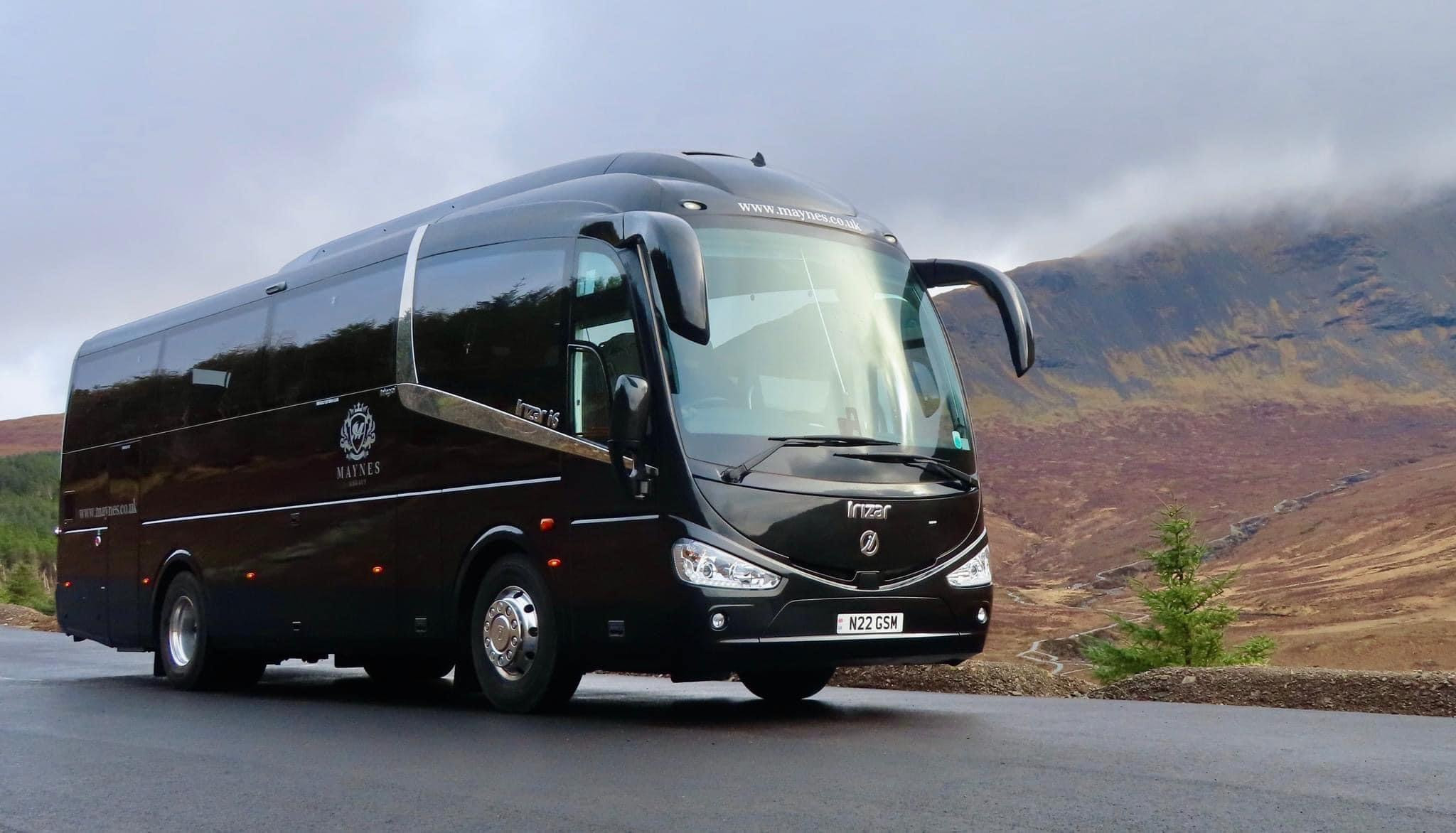
There’s a particular kind of stress that only shows up when you’re trying to move more than four people around Scotland. On your own, or as a couple, you throw a bag in the boot and go. With a group – a wedding party, a golf society, three generations of the same family, a walking club, a coachload of friends marking a big birthday – every decision suddenly has knock-on effects. One person’s idea of a relaxed day is another’s idea of being rushed off their feet. Someone can’t manage the walk to the castle. The single-track road that was a laugh in a hire car becomes a genuine problem in a 49-seat coach.
Living in Moray, I’ve watched a lot of group tours pass through – distillery minibuses on the Speyside run, wedding coaches heading for country-house venues, and the steady summer flow of larger tour buses working their way along the coast. The trips that go well and the ones that unravel usually come down to the same handful of planning decisions, made (or missed) weeks before anyone sets off. This is a practical guide to getting those decisions right, whoever you’re travelling with and however many of you there are.

Start with the group, not the map
The instinct when planning any Scottish trip is to open a map and start pinning the big names: Skye, Glencoe, Loch Ness, Edinburgh Castle. For a group, that’s the wrong first move. The single most useful thing you can do is work out honestly what kind of group you are, because that decides everything else.
A stag or hen weekend and a group of retired ramblers want completely different days, even if they end up at some of the same viewpoints. Ask yourself a few blunt questions before you plan a single mile:
- What’s the range of mobility and energy? If even one person struggles with stairs, uneven ground or long walks from the car park, that shapes which stops actually work.
- What’s the real reason for the trip? A celebration built around evenings together needs a very different rhythm from a sightseeing tour where the days are the point.
- How much time will genuinely be spent moving? Groups almost always underestimate this, and it’s where most itineraries fall apart.
- Who’s actually in charge? Someone needs to be the decision-maker on the day, or you’ll spend twenty minutes in every car park deciding what to do next.
I’ve always found that the groups who nail this bit – who accept what they are rather than what they’d ideally like to be – have far better trips. A gentle, generous itinerary that everyone enjoys beats an ambitious one that leaves half the group exhausted and the other half frustrated.
The distance trap: why Scotland is bigger than it looks
This is the mistake I see more than any other, and it catches first-time visitors and returning ones alike. On a map, Scotland looks compact. In practice, the roads that make it beautiful are the same roads that make it slow.
A distance that a mapping app quotes as an hour can easily take you half as long again, because the app doesn’t know about the tractor you’ll sit behind, the single-track section where you’ll crawl between passing places, the roadworks on the A9, or the simple fact that a group of fourteen people cannot use a roadside toilet and buy coffee in under forty minutes. Multiply all of that across a day of several stops and an ambitious itinerary quietly becomes an impossible one.
My rule of thumb for group planning is to take whatever driving time you’re quoted and add a comfortable margin – then be ruthless about how many stops you try to string together in a day. Three well-chosen stops with time to actually enjoy them will always beat six rushed ones seen mainly through a window. We cover the practical side of this in more detail in our guide to driving in Scotland, which is worth a read before any road-based tour.

Choosing how the group travels
How you move the group is the decision everything else hangs off, and it’s worth thinking through properly rather than defaulting to whatever’s cheapest on paper. There are broadly four options, each with a sweet spot.
A convoy of hire cars
Splitting into several hire cars gives each carload independence and works reasonably for groups of up to eight or so who are happy to travel in sub-groups. The downsides show up fast at scale: convoys get separated at junctions and lights, everyone needs to park, and you lose the shared experience of travelling together. It also quietly puts several people on the hook for driving on unfamiliar roads, which not everyone enjoys.
Self-drive minibus
A self-drive minibus (typically up to 16 seats) keeps everyone together and costs less than hiring a driver. The catch is that someone has to drive it – a large, unfamiliar vehicle on Scottish roads – and licence rules matter here. Drivers who passed their test after 1 January 1997 don’t automatically have the D1 category needed for larger minibuses, so check licences carefully before you book. It’s a solid option for confident groups on a budget, less so if nobody fancies being the designated driver for a week.
Minibus or coach with a driver
Hiring a vehicle with a professional driver is, for most larger groups, the option that removes the most stress. Nobody in the group has to navigate, park, stay sober, or reverse a long vehicle out of a tight glen. A good local driver often knows the roads, the sensible stopping points and the realistic timings better than any app. For a wedding, a distillery tour, a golf trip or a milestone birthday, it frees everyone to actually be on holiday. The trade-off is cost, and you’re working to the driver’s hours and the vehicle’s access limits – more on that below.
A mix
Plenty of well-run group trips combine approaches: a driver-led coach for the long touring days and the celebratory nights out, with a couple of hire cars or a minibus for smaller optional side-trips. There’s no rule that says the whole group has to travel identically for the entire trip.
The vehicle-size question nobody mentions until it’s too late
Here’s the piece of advice that separates a smooth group tour from a stranded one, and it’s something generic road-trip articles almost never spell out: the size of your vehicle decides which of Scotland’s best places you can actually reach.
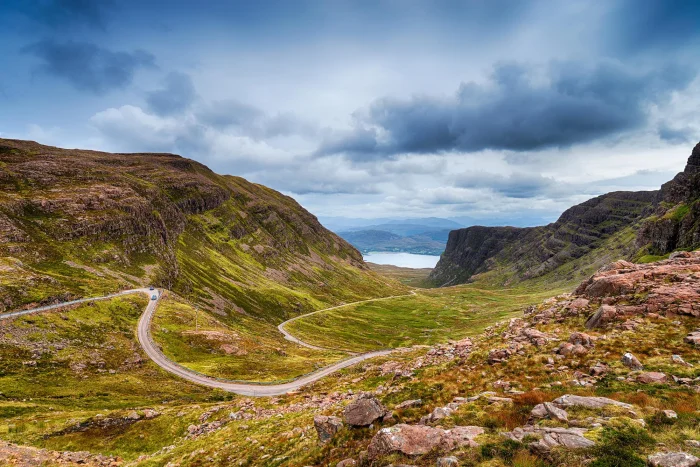
Some of the most photographed spots in the country sit at the end of roads that a full-size coach simply cannot use safely. The classic example is the Bealach na Bà, the mountain pass to the Applecross peninsula. It climbs to 626 metres through a series of severe hairpin bends on gradients as steep as one in five, and it’s expressly not suitable for large or long vehicles. Coaches and big motorhomes are strongly advised to take the gentler coastal route instead. It only takes one oversized vehicle stuck on a bend to block the road completely, for everyone including emergency services.
The same principle applies in gentler forms all over the Highlands and Islands. Many roads on Skye, in the far north-west and out to remote beaches narrow to single track with passing places. A skilled coach driver handles these routes every week, but there are places a 49-seater genuinely can’t or shouldn’t go – and if that’s where your group wants to be, you need to know before you book, not on the morning of.
This is exactly why so many organisers land on a smaller vehicle than their headcount alone would suggest, or split a big group across two minibuses rather than one full coach. A minibus can slip down a farm track to a wedding venue, into a town-centre hotel forecourt, and along roads a coach would struggle with. If your dream itinerary includes the tight, remote, single-track stuff, factor that into your vehicle choice from the very start.
Matching the vehicle to the group size and budget
Cost per head, not headline price, is the number that matters. A half-empty coach is expensive dead weight, while a vehicle that’s too small means squeezed passengers and nowhere for the luggage. As a rough guide:
- Up to around 8 people: a minibus (with or without driver) or a couple of hire cars usually makes the most sense.
- Roughly 8 to 16: a single minibus is the natural fit – small enough for most roads, big enough to keep everyone together.
- Larger groups: a coach starts to win on cost per person once you can genuinely fill it, but only if your itinerary suits a bigger vehicle. If it doesn’t, two minibuses can be the smarter choice.
Don’t forget luggage. Golf clubs, wedding kit, walking gear and a week’s worth of suitcases eat space fast, and a vehicle that seats everyone comfortably empty can be miserable once it’s loaded. Tell whoever you’re hiring from what you’re actually bringing.
Building the route: hub-and-spoke beats one-night stands
The most common group-tour mistake after the distance trap is moving hotels every single night. It sounds efficient – a new place each evening, maximum ground covered – but in practice it means packing, loading, checking in and checking out every day, which with a group is a genuine time sink and a reliable source of grumbling.
A far better model for most groups is hub-and-spoke: base yourselves somewhere central for two or three nights and do day-trips out and back. You unpack once, the evenings are relaxed, and you cut out all that dead time. Scotland lends itself to this beautifully, because a handful of well-placed hubs put a huge amount within a comfortable day’s reach.
Two or three hubs across a week – say the Central Belt, the Cairngorms or Speyside, and a west-coast or Highland base – will nearly always give a group a better trip than seven different hotels in seven nights. Our one week in Scotland guide and the various five-day itineraries on the site are useful for seeing how the distances actually stack up.
If you're sharing itineraries, booking details and travel documents via public Wi-Fi while organising the trip, using a VPN can add an extra layer of security for everyone involved.
Good hubs for a Scottish group tour
These are the bases I’d point most groups towards, chosen because each opens up a cluster of worthwhile stops without endless driving.
Edinburgh and the Central Belt
Almost every group tour starts here, and for good reason. Edinburgh is where most people arrive, it’s packed with things to do in its own right, and it’s within easy reach of Stirling, the Kelpies, the Falkirk Wheel and the Trossachs. It’s also the logical place to pick up a vehicle and driver for the touring days ahead – if you’re arranging transport from the capital, a firm offering Coach Hire Edinburgh can handle airport pick-ups and the run north without anyone in the group having to drive. Our complete guide to Edinburgh covers the city itself in depth.
Looking to see the sights at Scotland’s most populated city? Hire a car to explore Glasgow and the surrounding area, lovely areas at Falkirk and Stirling are not far away.
The Cairngorms and Speyside
Aviemore and the wider Cairngorms make an excellent middle-of-the-trip hub, with mountains, forests, lochs and wildlife on the doorstep and Speyside’s distilleries a short hop away. It’s a natural base for groups who want a mix of gentle outdoor time and a distillery day – and if drink is involved, a driver is close to essential. Our roundup of the best whisky distillery tours in Scotland is a good place to plan that side of things.
Inverness and the Highland capital
Inverness works well as a northern hub, putting Loch Ness, Culloden, the Moray coast and the start of the North Coast 500 within reach. It’s a comfortable size for a group, with plenty of accommodation and evening options.
Fort William and the west
For dramatic scenery – Glencoe, Glenfinnan, Ben Nevis and the road to the isles – a west-coast base around Fort William is hard to beat. Just keep the vehicle-access point in mind: some of the finest spots out here are on narrower roads.
A Skye or island base
Skye deserves more than a rushed day-trip, and if it’s central to your group’s wish list, basing yourselves there for a couple of nights pays off. It’s also the clearest case for thinking hard about vehicle size, given how many of its best corners sit on single-track roads. Our guide to things to do on the Isle of Skye will help you judge what’s realistic.
The logistics that quietly make or break a group trip
Once the shape of the trip is settled, it’s the small operational details that decide whether the days run smoothly. None of these are glamorous, but ignoring them is how good itineraries go wrong.
- Book everything for groups well ahead. Restaurants, distillery tours, castle tickets and accommodation all get much harder to arrange at group size, and the good options go early – especially in summer.
- Warn venues you’re a group. A café that can seat four walk-ins may not cope with sixteen arriving at once. A quick call ahead avoids a scramble.
- Plan the toilet and coffee stops. With a group, comfort breaks take real time and there aren’t services on every corner in the Highlands. Build them in deliberately.
- Sort out money in advance. Decide early how shared costs, entry fees and meals are split, so nobody’s doing awkward maths at every till.
- Think about accessibility properly. If anyone has mobility needs, check that stops, vehicles and accommodation genuinely work for them rather than assuming.
- Have a wet-weather plan. Scottish weather turns, and a group stuck in the rain with no indoor fallback is a long afternoon. Distilleries, museums and the like make good all-weather options.
- Know the midge season. From roughly late spring into late summer, the west and Highlands can be midgy. It won’t ruin a trip but it’s worth a warning – see our guide to midges in Scotland.
If you’re driving the far north, our page on petrol stations on the NC500 is a genuinely useful bit of forward planning – fuel is sparse in places, and a group vehicle running low miles from a pump is a headache you can avoid.
When to go
Timing matters more for groups than for solo travellers, because a group amplifies everything. Peak summer brings the best chance of long daylight and open attractions, but also the highest prices, the busiest roads and the most competition for group bookings. Late spring and early autumn are, to my mind, the sweet spot for a tour: quieter roads, easier bookings, still-generous daylight and often lovely light for photography. Winter tours are perfectly doable and can be magical, but shorter days and the chance of weather disruption mean tighter, more conservative planning. Our guide to the best time of year to visit Scotland goes into this in detail.
Frequently asked questions
How many stops should we plan per day on a group tour?
For most groups, three meaningful stops a day is plenty, with generous travel and break time between them. Groups move slower than individuals at every stage – getting on and off the vehicle, toilets, coffee, photos – so an itinerary that looks comfortable on paper is often too full in practice. Fewer, better stops nearly always makes for a happier day.
Is it better to hire a coach with a driver or drive ourselves?
It depends on group size, budget and where you want to go. A driver removes navigation, parking, licensing and drink-driving worries and lets everyone relax, which suits weddings, distillery tours and larger groups. Self-drive is cheaper and gives more spontaneity, but puts the responsibility on someone in the group and comes with licence rules for larger minibuses. For many groups, a driver-led vehicle is the lower-stress choice.
Can a coach reach all the famous Highland spots?
No, and this is a common surprise. Some of Scotland’s best-known places sit at the end of steep or single-track roads that full-size coaches can’t use safely – the Bealach na Bà to Applecross is the classic example. If your itinerary includes remote or single-track routes, a minibus or a split into two smaller vehicles often makes more sense than one large coach. Always check access before booking.
How far ahead should we book group travel and accommodation?
Earlier than you think, especially for summer trips. Group accommodation, restaurant tables, distillery tours and popular attraction tickets all get harder to secure at group size, and vehicles with drivers book up in peak season. Several months ahead is sensible for a summer group tour; even off-season, a few weeks’ notice makes everything easier.
What’s the biggest mistake groups make when planning a Scottish tour?
Underestimating driving times and trying to cram in too much. Scotland is bigger and slower to travel than the map suggests, and a group compounds every delay. The second most common mistake is changing hotels every night instead of using one or two hubs, which wastes hours on packing and check-ins that could have been spent enjoying the place.
Should the whole group travel in one vehicle?
Not necessarily. Where your itinerary includes tight or remote roads, two minibuses can reach places a single coach can’t, and splitting the group can actually add flexibility for optional side-trips. Think about where you want to go before assuming one big vehicle is the answer.
A final thought
The best group trips through Scotland I’ve come across weren’t the ones that ticked off the most castles or covered the most miles. They were the ones where the planning did the hard work in advance – realistic distances, the right vehicle for the roads, a base or two instead of a nightly reshuffle – so that on the days themselves, everyone could just look out of the window and enjoy the country going by. Scotland rewards a slower, more considered pace, and with a group that’s not a compromise. It’s the whole point. Get the logistics right and the memories more or less take care of themselves.
All information was correct at the time of writing, please check things like entry costs and opening times before you arrive.


Leave a comment below