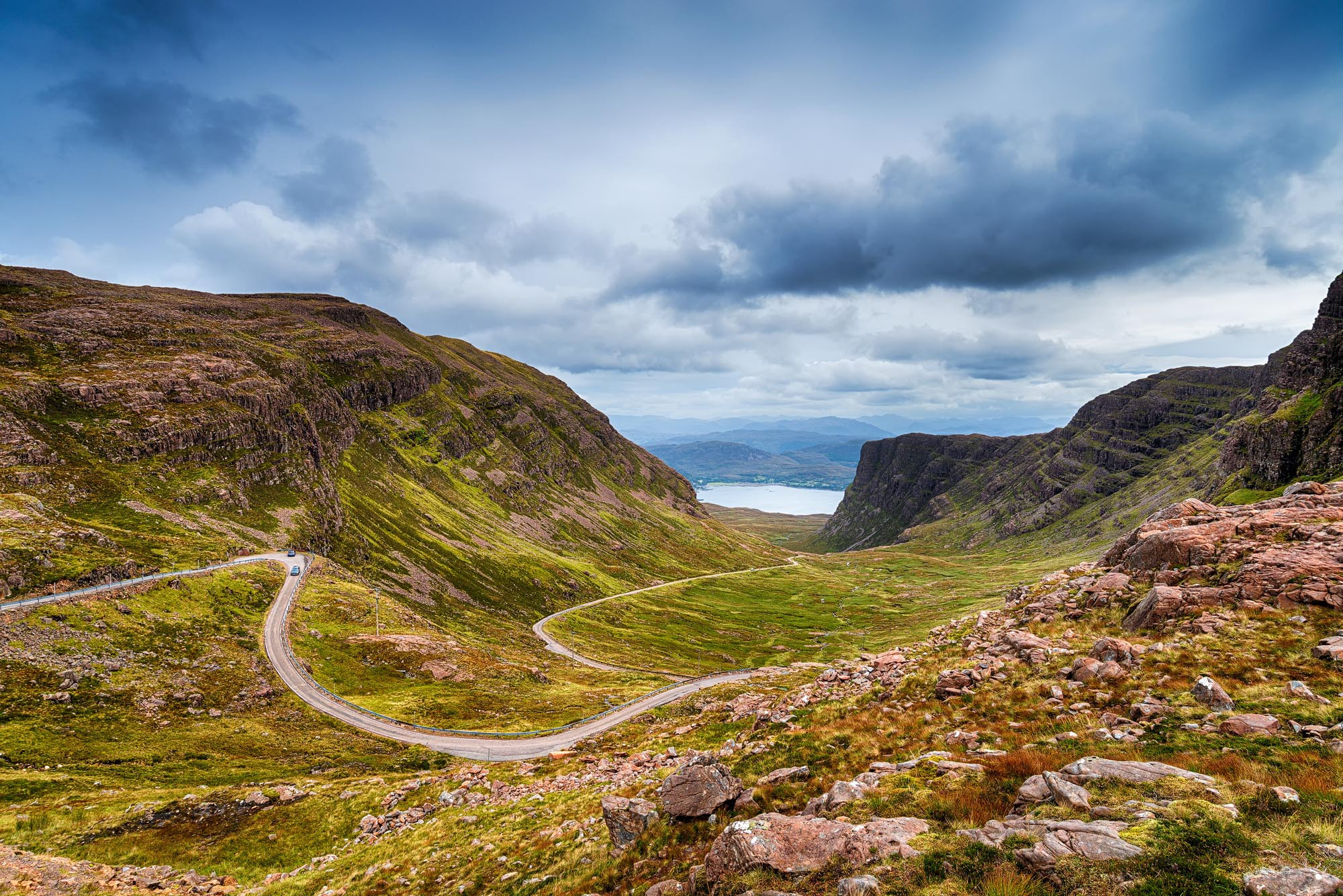
Scotland is one of the most visually dramatic countries on the planet. Rugged coastline, ancient castles, moody glens, wild mountains – it’s the kind of landscape that practically begs to be filmed. No wonder so many creators are drawn here, cameras in hand, ready to capture something spectacular.
But here’s what nobody tells you before your first shoot: Scotland will test your equipment, your patience, and your planning in ways that a studio setup or a sunny Mediterranean vlog never will. The wind alone can ruin an entire day’s audio. The rain can appear from nowhere and vanish just as fast. The midges – well, we’ll get to the midges.
I’ve been filming content across Scotland for years, flying drones over castles, shooting video along the Moray coast, and producing articles and footage for Live Breathe Scotland. Janette and I have driven thousands of miles across the Highlands and islands chasing the right light, the right conditions, and the right moment. Along the way, I’ve learned what works, what doesn’t, and what I wish someone had told me before I started.
This guide is everything I’d want to know if I were planning my first vlogging trip to Scotland. It’s not a generic “how to start a YouTube channel” article. It’s specifically about the practical realities of filming here – the gear that survives Scottish conditions, the regulations you need to understand, and the tricks that separate a frustrating shoot from a brilliant one.
Choose Your Gear for Scottish Conditions
Every vlogging guide on the internet will tell you that your smartphone is good enough to start with. And technically, that’s true. Modern flagship phones shoot excellent video. But Scotland adds a layer of complexity that most gear recommendations don’t account for.
The single most important feature in any camera you bring to Scotland is weather sealing. Not weather resistance, not splash-proof – actual weather sealing. Scotland’s rain isn’t always the gentle drizzle people imagine. It can come in sideways, driven by wind that makes holding a camera steady a genuine challenge. If your camera can’t handle moisture, you’ll spend half your time protecting it instead of using it.
If you’re using a phone, invest in a decent waterproof case that still allows touchscreen operation. If you’re shooting on a dedicated camera, models with IP-rated weather sealing are worth the extra cost. Micro four thirds systems like the OM System range have earned a strong reputation among photographers and videographers working in Scottish conditions, precisely because they’re built for exactly this kind of punishment.
Beyond the camera body, think about stabilisation. Scotland’s landscapes reward movement – walking shots along coastal paths, sweeping pans across glens, handheld tracking through forest trails. Built-in image stabilisation helps enormously, but a gimbal or a camera with excellent in-body stabilisation will make a visible difference to your footage. Shaky, windblown video screams amateur, regardless of how stunning the location is.
A few essentials that are optional elsewhere but mandatory here:
- Microfibre cloths – plural. You’ll be wiping rain, mist, and condensation off your lens constantly. Carry at least three.
- Silica gel packets in your camera bag. Scotland’s humidity will find its way into everything.
- Spare batteries – more than you think you need. Cold temperatures drain batteries significantly faster, and Scottish winter shoots can halve your expected battery life.
- A rain cover for your camera bag. Not optional. A wet bag means wet everything.
- A sturdy tripod that won’t blow over. Lightweight travel tripods are fine in calm conditions, but on an exposed Highland ridge, you need something with weight or a hook for hanging a stabilising bag.
Audio – Scotland’s Biggest Production Challenge
I cannot overstate this: wind noise will be the single biggest technical problem you face when vlogging in Scotland. It’s not an occasional nuisance. On many days, particularly on the coast and at elevation, wind is a constant companion that will destroy your audio if you’re not prepared.
The built-in microphone on your camera or phone is essentially useless outdoors in Scottish conditions. Even on what feels like a calm day, there’s usually enough breeze to create that deep, rumbling interference that drowns out speech. You need an external microphone, and you need wind protection for it.
A wireless lavalier microphone clipped inside your collar is the most reliable option for pieces to camera. The collar provides a natural windbreak, and positioning the mic on the leeward side of your body – the side facing away from the wind – can reduce wind noise dramatically. Your body creates a turbulence shadow that genuinely makes a difference.
If you’re using a shotgun microphone mounted on your camera, a foam windscreen alone won’t cut it. You need a furry windshield – often called a deadcat – which uses dense artificial fur fibres to break up turbulent airflow before it reaches the microphone capsule. A good deadcat can reduce wind noise by 20 to 30 decibels compared to a bare microphone. In Scottish conditions, it’s the difference between usable audio and unusable rumble.
A few practical audio tips for filming in Scotland:
- Record a “room tone” sample at every location – even outdoors. Thirty seconds of ambient sound with no talking gives you material for noise reduction in post-production.
- If the wind is too strong for clean audio, film your B-roll footage and record your voiceover later in a sheltered spot or indoors. Many successful Scotland vloggers use voiceover narration over landscape footage for exactly this reason.
- Consider recording audio separately on a dedicated recorder as a backup. Syncing in post takes a few extra minutes but can save an otherwise ruined shoot.
- Avoid changing your microphone position between takes at the same location. Consistency matters more than perfection.
Understanding Scotland’s Light
Scotland sits between 55 and 61 degrees north latitude. That might not mean much on paper, but in practice, it creates some of the most extreme seasonal light variation you’ll encounter anywhere in western Europe – and it’s one of the biggest advantages Scotland offers to content creators who understand how to use it.
In midsummer, Scotland gets extraordinarily long days. At the summer solstice, Edinburgh enjoys over 17 and a half hours of daylight, while Shetland gets more than 19 hours, with barely four hours of true darkness. The golden hour – that warm, soft light just after sunrise and before sunset that every filmmaker craves – can last significantly longer here than at lower latitudes. Where golden hour might last 30 minutes near the equator, in Scotland it can stretch to well over an hour, sometimes longer.
The catch? In midsummer, golden hour happens very early and very late. Sunset in the Scottish Highlands in June might not happen until after 10pm, meaning that gorgeous warm light arrives when most people have packed up for the day. If you’re willing to stay out late or get up at 4am, you’ll have spectacular conditions almost entirely to yourself.
Winter is the opposite. Daylight can shrink to six or seven hours in the Highlands, with the sun barely climbing above the horizon. But there’s a silver lining for filmmakers: because the sun stays so low, the light retains a golden quality for much of the short day. Winter golden hour in Scotland can effectively last for hours rather than minutes. The trade-off is that you have a very narrow window to work in, and the weather is less predictable.
Spring and autumn offer arguably the best balance for vlogging. Reasonable daylight hours, golden hour periods of 45 to 75 minutes, and the dramatic seasonal colours – heather in late summer, autumn foliage in October, snow-dusted peaks from November – all contribute to visually striking footage.
One more thing about Scottish light that surprises visitors: overcast days are not the enemy. Cloud cover creates soft, diffused light with no harsh shadows, making it actually easier to film evenly lit footage. Some of the most atmospheric Scottish footage you’ll ever see was shot under heavy grey skies, with moody clouds rolling across mountains. Embrace the weather rather than waiting for sunshine that might never arrive.
Filming in Scottish Weather
There’s a saying in Scotland: if you don’t like the weather, wait twenty minutes. It’s a cliché because it’s true. I’ve had mornings where I’ve driven through torrential rain, arrived at a location in blazing sunshine, filmed for an hour under clear skies, and then retreated to the car as hail hammered the windscreen. All before lunchtime.
This unpredictability is simultaneously Scotland’s greatest frustration and its greatest gift for content creators. Those rapid weather changes produce dramatic skies, sudden shafts of light breaking through cloud, and atmospheric conditions that would take a Hollywood lighting crew thousands of pounds to recreate. A flat blue sky is actually the least interesting backdrop for Scottish landscape footage.
Practical weather tips for filming in Scotland:
- Layer your clothing. You’ll be standing around between shots, moving between locations, and potentially dealing with temperature swings of ten degrees in a single day.
- Waterproof outerwear is non-negotiable. Not water-resistant – waterproof. A good hardshell jacket and waterproof trousers will keep you functional when conditions deteriorate.
- Keep your camera bag closed when you’re not actively accessing it. Scottish rain finds its way into everything.
- Carry lens wipes and cloths in an easily accessible pocket, not buried in your bag. You’ll need them constantly.
- Check the forecast, but don’t rely on it absolutely. Mountain Weather Information Service (MWIS) gives far more useful detail for Highland locations than standard weather apps.
- Accept that some days will be write-offs. Build flexibility into your schedule. If you’re travelling specifically to film, plan for more days than you think you need.
Surviving Midge Season
If you’ve never experienced Scottish midges, let me paint the picture. They’re tiny – just one to three millimetres – and individually they’re barely noticeable. But they don’t operate individually. They swarm in clouds of thousands, descending on any exposed skin, leaving itchy red welts that can make you genuinely miserable. And they appear in the places where you most want to film – sheltered glens, woodland edges, still loch shores – during the season when Scotland looks its most lush and green.
Midge season runs from late May to mid-September, with peak activity in July and August, particularly in the western Highlands. Check the Scottish midge forecast before planning any outdoor shoot during these months. They’re at their worst at dawn and dusk in calm, humid, overcast conditions – which, unfortunately, is also when the light is often at its most atmospheric.
For vloggers, midges create a specific problem beyond personal discomfort. Standing still to deliver a piece to camera, in a sheltered beauty spot, at golden hour in July? That’s prime midge territory. They’ll be in your eyes, your ears, and flying into your mouth mid-sentence.
How to manage them:
- Wind is your best defence. Anything above about 7mph disperses them completely. Choose exposed, breezy filming locations during peak midge season.
- Smidge repellent (using IR3535) is widely regarded as the most effective option for Scottish conditions. Apply to all exposed skin before you start filming.
- A midge head net costs about eight pounds, weighs almost nothing, and provides complete protection. It’s not flattering on camera, but it’s essential for setup time between shots.
- Plan your piece-to-camera segments for the middle of the day, when midges are least active. Save the dawn and dusk hours for landscape B-roll where you can cover up more easily.
- The east coast is generally less affected than the west. If midges are truly unbearable, shifting your itinerary eastward can help.
Living in Moray, on the northeast coast, I’m lucky that midges are less of an issue here than they are in the western Highlands. But even here, a still summer evening near the river can produce enough of them to make outdoor filming uncomfortable. Always be prepared.
Drone Filming in Scotland
Scotland’s landscape is spectacularly suited to aerial footage. The scale of the mountains, the patterns of the coastline, the way castles sit within their landscapes – drone footage reveals all of this in a way that ground-level filming simply cannot match. Some of my favourite content has come from aerial work over locations like Eilean Donan Castle and along the Moray Firth coast. The perspective a drone provides transforms how people see these places.
But drone filming in Scotland comes with a serious regulatory framework that you need to understand before you fly. Getting it wrong can result in fines, confiscation of your equipment, or even criminal prosecution.

Registration and Licensing
If you’re flying a drone in Scotland, UK Civil Aviation Authority (CAA) rules apply. Aviation is a reserved matter under the Scotland Act 1998, which means the same regulations govern drone flights across all of England, Scotland, Wales, and Northern Ireland.
There are two registration requirements, and you may need both:
- Flyer ID – obtained by passing an online theory test. Required for anyone who physically flies a drone.
- Operator ID – required for anyone responsible for a drone or model aircraft. Must be displayed on the drone itself. Required for all drones with cameras, regardless of weight, and for any drone weighing over 250 grams.
Both can be obtained through the CAA’s registration service. It’s straightforward and inexpensive, but flying without the required IDs is against the law. There’s no grey area here.
The Rules of the Air
Most recreational and small-scale vlogging drone flights fall within the CAA’s Open Category, which covers low-risk flying under these conditions:
- Maximum altitude of 120 metres (400 feet) above ground level.
- Must maintain Visual Line of Sight (VLOS) at all times – meaning you need to be able to see the drone with your own eyes, not just through the controller screen.
- Keep away from uninvolved people. The exact distance depends on your drone’s weight and class marking, but a minimum of 50 metres from people is the general guideline for most consumer drones.
- Do not fly over crowds or organised gatherings.
- As of January 2026, a green flashing anti-collision light is mandatory for any drone flight after sunset.
The Open Category is subdivided into A1, A2, and A3, based on drone weight, proximity to people, and whether you’re flying in built-up areas. For most vloggers using consumer drones like the DJI Mini series (under 250g) or the DJI Air range, the A1 or A2 subcategory applies. Heavier drones are restricted to the A3 subcategory, which requires you to fly well away from residential, commercial, and industrial areas.
If you’re producing content commercially – and a monetised YouTube channel can fall into this category for larger operations – you may need a General Visual Line of Sight Certificate (GVC) and a CAA Operational Authorisation. This is more relevant to production companies than individual vloggers, but it’s worth understanding where the line sits.
Flight Restriction Zones in Scotland
This is where Scotland-specific knowledge becomes essential. Flight Restriction Zones (FRZs) exist around every airport, and Scotland has a lot of them. Beyond the obvious ones at Edinburgh, Glasgow, Aberdeen, and Inverness, the Highlands and Islands Airports Limited (HIAL) network includes smaller airports at Wick, Kirkwall, Sumburgh, Stornoway, Benbecula, Barra, Tiree, Islay, Campbeltown, and Dundee. Each has an FRZ that restricts drone operations in the surrounding airspace.
Before every flight, check the airspace using the CAA’s Drone and Model Aircraft Registration service or the NATS Drone Assist app. What looks like an unrestricted rural location on the ground might sit within an airport’s controlled airspace from the air.
Heritage Sites and Protected Areas
Scotland’s most photogenic locations are often managed by organisations with their own drone policies:
- Historic Environment Scotland (HES) manages over 300 properties including Edinburgh Castle, Stirling Castle, and sites like Ruthven Barracks. Drone flying at or near HES properties requires permission, and it is frequently refused for non-commercial recreational use.
- National Trust for Scotland (NTS) has a blanket ban on drone flying at most of its properties without prior written permission.
- NatureScot manages access agreements for protected landscapes including Sites of Special Scientific Interest (SSSIs) and National Nature Reserves. Many of the iconic Highland locations that international vloggers want to film – the Quiraing, the Old Man of Storr, much of the Skye coastline – fall under NatureScot oversight. Drone operations here require permission, particularly during nesting season when disturbance to ground-nesting birds like golden eagles, hen harriers, and red-throated divers can result in prosecution under the Nature Conservation (Scotland) Act 2004.
- Forestry and Land Scotland manages large areas of woodland and open land. Policies vary by location.
- Cairngorms and Loch Lomond & The Trossachs National Parks both advise caution and, in some areas, restrict drone activity, particularly near visitor centres, nature reserves, and busy areas.
The key message is this: just because Scotland’s right to roam allows you to walk freely across most land doesn’t mean you can fly freely above it. The right to roam under the Land Reform (Scotland) Act 2003 explicitly does not extend to aerial access. Ground access and air access are governed by entirely separate frameworks.
Practical Drone Tips for Scotland
Beyond the regulations, Scotland presents some specific practical challenges for drone operators:
- Wind. Scotland is frequently windy, and the wind at altitude is almost always stronger than at ground level. Most consumer drones have a maximum wind resistance of around 30 to 40 km/h. Check conditions before launching, and be aware that gusting is common, particularly around mountains and coastal cliffs where the terrain creates turbulence. If the wind is marginal, don’t risk it. A drone lost over a Scottish sea cliff or loch is gone for good.
- Cold and batteries. Cold weather significantly reduces battery performance. In winter conditions, you might lose 20 to 30 percent of your expected flight time. Keep spare batteries warm inside your jacket until you need them, and plan shorter flights in cold weather.
- Rain. Most consumer drones are not waterproof. Light drizzle can be manageable with caution, but flying in rain risks damage to motors, electronics, and sensors. If it starts raining mid-flight, bring the drone home immediately.
- Compass calibration. Scotland’s geology includes significant iron-bearing rock, particularly in the Highlands. Magnetic interference can affect compass calibration on your drone. If the controller prompts you to calibrate, do so – and if the compass readings seem erratic, don’t fly. A confused compass can cause a drone to fly erratically or enter a toilet-bowl spin.
- Wildlife disturbance. Even where you have legal permission to fly, be aware of wildlife. Raptors, including golden eagles and white-tailed eagles, will sometimes investigate or attack drones they perceive as intruders. Red deer are easily spooked by drone noise. Sea birds nesting on cliffs can abandon nests if disturbed. Fly responsibly, maintain distance from animals, and if wildlife shows signs of distress, bring the drone back.
- Pre-flight planning. I make a habit of checking several things before every flight: CAA airspace restrictions, weather conditions and wind speed at altitude, any local notices or restrictions, battery charge levels, and a visual assessment of the area for obstacles and wildlife. It takes five minutes and has saved me from problems more times than I can count.
If drone filming is central to your Scotland vlogging plans, I’d strongly recommend starting with a sub-250g drone like the DJI Mini series. These drones fall into the lightest regulatory category, require fewer restrictions under the Open Category A1 subcategory, and are far less likely to cause damage in the event of a crash – which matters from both a safety and a liability perspective. They’re also small enough to carry comfortably alongside your other filming gear, which counts for a lot when you’re hiking to remote locations.
Access Rights and Filming Permissions
Scotland’s right to roam is one of the most generous public access frameworks in Europe. Under the Land Reform (Scotland) Act 2003, everyone has the right to access most land and inland water for recreational purposes, including photography. This is a genuine advantage for vloggers – in England, for example, your access would be far more restricted.
The Scottish Outdoor Access Code sets out what responsible access looks like. The key principles are simple: don’t interfere unreasonably with other people’s rights, and act lawfully and reasonably. For a vlogger walking across open land, filming landscapes, and talking to camera, this is almost always fine.
Where it gets more complicated is the distinction between recreational and commercial filming. The Land Reform Act explicitly excludes certain commercial activities from access rights. If you’re a solo vlogger with a camera and a small following, you’re almost certainly exercising recreational access rights. If you’re part of a production crew, using vehicles and equipment, restricting public access, or filming for a commercial broadcast, you’ll likely need specific permissions from the landowner or managing organisation.
The grey area sits in the middle, and there’s no definitive legal test for when a YouTube channel crosses from recreational to commercial. As a general principle: if your filming doesn’t require exclusive access, doesn’t disrupt other people, and doesn’t involve anything beyond what a recreational visitor might do, access rights should cover you. If in doubt, ask.
Some specific situations to be aware of:
- Historic sites managed by HES or NTS may have their own rules about filming, even for personal content. Check before you go.
- Edinburgh and Glasgow city centres may require council permits for anything beyond handheld personal filming.
- Private estates, particularly during deer stalking season (typically July to October for stags), may request that you follow specific routes. This is about safety, not access – a stray person on a hill during a stalk creates a genuine danger.
- Always respect people’s privacy. Pointing a camera at someone’s house, children, or private activities goes beyond responsible access.
Planning for Patchy Mobile Signal
If you’re used to filming in cities where 4G or 5G coverage is everywhere, Scotland will be a rude awakening. Large areas of the Highlands and Islands have no mobile signal at all – from any provider. One study found that 34 miles of the North Coast 500 route alone have zero 4G coverage from any of the four main networks. Hundreds more miles have only partial coverage from one or two providers.
This has improved recently, with the UK Government’s Shared Rural Network programme funding new 4G masts across rural Scotland – over 50 have been switched on so far. But coverage remains patchy, particularly in remote glens, mountain areas, and the more isolated islands.
For vloggers, this matters in several ways:
- Don’t plan to upload content from remote locations. Download everything you need – maps, research notes, shot lists – before you leave signal range.
- Download offline maps. Google Maps, OS Maps, and similar apps all offer offline map downloads. Do this over Wi-Fi before you head out. Navigation relying on a live data connection will fail you exactly when you need it most.
- Carry a paper road atlas. It sounds old-fashioned, but when your phone has no signal and no GPS lock, a physical map is the only option. OS Landranger maps are excellent for detailed terrain information.
- If you’re filming in genuinely remote areas – deep glens, mountain summits, offshore islands – consider a personal locator beacon or satellite communicator for safety. This is particularly relevant if you’re working alone.
Where to Point Your Camera
Scotland doesn’t lack for photogenic locations. The challenge is often the opposite – there’s so much to film that it’s easy to end up with hours of footage and no coherent story. Before you start filming, decide what your video is actually about. A Scotland vlog needs a narrative thread, not just a highlight reel of pretty scenery.
That said, some locations are iconic for a reason and will give you immediately recognisable footage that connects with audiences:
- Glen Coe – Scotland’s most dramatic valley. The Three Sisters, the winding A82, the ever-changing light. It’s been filmed thousands of times and still manages to look spectacular every time.
- Isle of Skye – The Quiraing, the Old Man of Storr, the Fairy Pools, Neist Point. Skye is essentially a vlogger’s dream, though it gets extremely busy in summer.
- Eilean Donan Castle – One of the most photographed castles in Scotland, sitting where three lochs meet. Stunning from the ground and from the air (with appropriate permissions).
- The Cairngorms – Mountain scenery, ancient Caledonian pine forest, and wildlife including red squirrels, red deer, and golden eagles. The Highland Wildlife Park near Kingussie is excellent for wildlife footage you might never capture in the wild.
- Edinburgh and Glasgow – Don’t overlook the cities. Edinburgh’s architecture and atmosphere are world-class, and Glasgow’s street art, music scene, and Victorian buildings offer a completely different visual palette.
But I’d encourage you to look beyond the obvious. Some of my most rewarding footage has come from lesser-known locations. The Moray coast, where I live, has stunning clifftop walks, deserted beaches, and the kind of quiet, unspoilt scenery that the tourist hotspots have lost. The Bin of Cullen near Buckie offers panoramic views across the Moray Firth. The Fyrish Monument in Easter Ross sits on a hilltop with views across the Cromarty Firth and provides a far more interesting story than many better-known sites.
The less-filmed locations also mean less competition for attention online. A hundred vloggers have filmed the Old Man of Storr. Fewer have explored the fishing villages of the Moray coast or the remote glens of Wester Ross. Finding your own angle on Scotland – rather than replicating what everyone else has already done – is what will make your content stand out.
Building Your Scotland Channel
Creating great footage is only half the battle. If nobody sees it, it doesn’t matter how beautiful your drone shots are or how well you’ve dealt with the wind noise. Building an audience takes deliberate effort, and for Scotland-specific content, there are some particular strategies worth considering.
Find Your Niche
“Scotland travel vlog” is not a niche. It’s a category, and it’s already crowded. What makes your perspective on Scotland different? Perhaps you’re focused on history, wildlife, Gaelic culture, outdoor adventures, food, whisky, or filming locations. The more specific your angle, the easier it is for YouTube’s algorithm to understand who your audience is and recommend your content to them.
Use Short-Form Content for Discovery
YouTube Shorts, TikTok, and Instagram Reels are where new audiences discover creators. Scotland’s landscapes lend themselves perfectly to short, visually striking clips. A 30-second drone clip over a misty glen, a quick tip about surviving midges, a time-lapse of clouds racing across a mountain – these work brilliantly as short-form content that drives viewers to your longer videos.
Cross-Platform Consistency
Post consistently across platforms and keep your branding recognisable. Use the same handle everywhere. Tease your YouTube videos on Instagram with behind-the-scenes content. Post clips on TikTok. Build an email list if you’re serious about long-term growth. Each platform serves a different purpose – YouTube for long-form, Shorts and TikTok for discovery, Instagram for community, email for direct connection.
Growing Your Initial Audience
The hardest phase of any channel is the beginning, when you’re producing content that barely anyone sees. Building momentum takes time, and there are legitimate tools and services that can help accelerate early growth. Platforms like SocialWick offer social media growth services across YouTube, Instagram, TikTok, and other platforms, helping new creators build the initial visibility that organic growth alone can take months to achieve. Combining this kind of strategic audience building with genuinely good content gives you the best chance of gaining traction.
Music and Copyright
Background music transforms a vlog from a talking-head video into an atmospheric experience, but using commercial music will get your video demonetised or taken down. YouTube’s Content ID system scans every uploaded video against a database of copyrighted audio, and if it finds a match, the rights holder takes your revenue or blocks the video entirely.
The safest free option is the YouTube Audio Library, built directly into YouTube Studio, which pre-clears tracks specifically for the platform. For higher-quality options, services like Epidemic Sound and Artlist offer subscription-based libraries with full licensing. Both are popular with travel vloggers and provide tracks searchable by mood, energy, and genre. It’s an ongoing cost, but losing revenue to copyright claims costs more.
Frequently Asked Questions
What camera equipment do I need for vlogging in Scotland?
The most important feature is weather sealing. Scotland’s rain and wind will challenge any equipment, so a weather-sealed camera body, a waterproof case for your phone, microfibre cloths, silica gel packets, spare batteries, and a sturdy tripod are all essential. A wireless lavalier microphone with a deadcat windshield is strongly recommended for usable audio in windy conditions. You can start with a smartphone, but invest in weather protection and an external microphone before anything else.
Do I need permission to film or vlog in Scotland?
For most personal and small-scale vlogging, Scotland’s right to roam under the Land Reform (Scotland) Act 2003 allows you to access most land and film freely, as long as you behave responsibly. Specific heritage sites managed by Historic Environment Scotland or the National Trust for Scotland may have their own filming policies. Commercial productions – larger crews, exclusive access, or significant equipment – typically require permits. Drone filming has additional restrictions covered by CAA regulations.
Do I need to register my drone to fly in Scotland?
Yes. Anyone flying a drone with a camera must register for a CAA Operator ID, which must be displayed on the drone. Anyone who physically flies a drone must hold a Flyer ID, obtained by passing an online theory test. Drones must be flown below 120 metres, within visual line of sight, and away from uninvolved people. Flight Restriction Zones around airports and certain heritage and nature sites add further limitations. Always check airspace restrictions before flying.
When is the best time of year to vlog in Scotland?
May, early June, and September offer the best balance of long daylight hours, manageable weather, and lower midge activity. July and August provide the longest days and warmest temperatures but bring peak midge season and the highest tourist numbers. Winter offers dramatic light and empty landscapes but very short days and unpredictable weather. Each season has its advantages depending on the type of content you want to create.
How do I deal with wind noise when filming outdoors in Scotland?
An external microphone is essential – built-in microphones are effectively useless in Scottish wind conditions. A wireless lavalier mic clipped inside your collar provides natural wind protection. For camera-mounted shotgun microphones, a furry windshield (deadcat) can reduce wind noise by 20 to 30 decibels. Positioning yourself with your back to the wind, recording voiceovers in sheltered spots, and capturing ambient sound for noise reduction in post-production are all effective strategies.
Are there areas in Scotland with no mobile phone signal?
Yes, large areas of the Highlands and Islands have no mobile coverage from any provider. Even major touring routes like the North Coast 500 have significant stretches with no 4G signal. Always download offline maps before heading into remote areas, carry a paper map as backup, and don’t plan to upload content or rely on live data connections outside towns and villages. EE generally provides the widest coverage in Highland areas.
How bad are midges, and how do I avoid them while filming?
Midges are a genuine issue from late May to mid-September, peaking in July and August, particularly in the western Highlands. They’re worst at dawn and dusk in calm, humid, overcast conditions. Wind above 7mph disperses them completely. Use Smidge repellent on exposed skin, carry a midge head net, film pieces to camera during the middle of the day when midges are least active, and choose breezy, exposed locations over sheltered glens during peak season.
Final Thoughts
Scotland will reward you with footage that no other country in Europe can match. The landscapes are extraordinary, the light is unlike anything you’ll experience further south, and there is a depth of history, culture, and wildlife here that provides endless material for content creators willing to put in the work.
But it demands respect. This isn’t a destination where you can rock up with a phone and wing it. The weather, the terrain, the regulations, and the sheer remoteness of some locations all require preparation that you simply don’t need when filming in a city or a studio.
The creators who produce the best Scotland content are the ones who treat the country as a partner rather than a backdrop. Learn how the light works. Understand the access rules. Prepare for the weather. Respect the wildlife. Plan for the signal black spots. And when everything comes together – the right light, the right location, a break in the wind – be ready to capture it, because those moments are what make filming in Scotland truly special.
All information was correct at the time of writing, please check things like entry costs and opening times before you arrive.


Leave a comment below