Most of Scotland’s best-known places are surprisingly easy to reach. You can be at Loch Ness, Glencoe or the Kelpies within a few hours of landing in Edinburgh or Glasgow, and plenty of visitors see a remarkable amount without ever leaving the main roads. But some of the places that stay with you longest are the ones that make you work a little harder. They sit at the end of single-track roads, across sea lochs with no bridge, or a long overnight ferry north of the mainland.
This article picks out five Scottish escapes that I genuinely think are worth the extra miles: Knoydart, Sandwood Bay and Cape Wrath, Harris and Lewis (with an optional leap to St Kilda), Orkney and Shetland. For each one I’ve covered what makes it special, how you actually get there, and the practical details that most round-ups skip, from ferry timings to the dig site you can no longer see.

What Makes a Place Worth Travelling Further For?
Remoteness on its own isn’t a reason to go anywhere. A long journey only pays off if the place at the end of it gives you something you can’t get closer to home. When choosing these five, I looked for places that offer at least a couple of these:
- Landscape on a different scale - beaches, cliffs or mountains that feel properly wild rather than managed
- History you can stand inside - not just ruins, but places where you get a real sense of how people lived
- Wildlife in serious numbers - seabird colonies counted in tens of thousands, not a distant puffin on a rock
- A living community - somewhere with its own culture, not just a viewpoint with a car park
- The journey itself - a ferry, a walk-in or a flight that becomes part of the story
Every one of these escapes needs planning. Ferries sell out, weather cancels boats, and some places have no shop, no phone signal and no road. That’s precisely why they feel the way they do.
1. Knoydart - Mainland Britain’s Roadless Peninsula
Knoydart is a strange and wonderful thing: a chunk of the Scottish mainland that you cannot drive to. The peninsula sits between Loch Nevis and Loch Hourn on the west coast of Lochaber, and it is cut off from the UK road network entirely. You either arrive by boat or on foot.
The main village, Inverie, is home to roughly a hundred people. It has a primary school, a community shop and post office, a pottery and tearoom, a small brewery in a former chapel and, most famously, The Old Forge. Guinness World Records lists it as the remotest pub in mainland Britain, and walkers have been treating it as a pilgrimage for decades.

A Community That Bought Its Own Home
What makes Knoydart more than a pretty place is its story. In 1999 the community, working through the Knoydart Foundation, bought 17,500 acres of the Knoydart Estate, making it one of the earliest community buyouts in Scotland. The Foundation is a partnership of residents, the Highland Council and conservation bodies including the John Muir Trust.
The same spirit came round again when The Old Forge went up for sale in 2021. Residents raised more than £320,000 through a community share offer and crowdfunder, and the pub reopened under community ownership in spring 2022. Profits now go back into the business and community projects rather than to a private owner. I find that genuinely moving, and it changes how a pint there feels. You’re not just a customer, you’re helping keep the place going.
The history isn’t all happy. Like much of the west Highlands, Knoydart was hit hard by the Highland Clearances, and many families emigrated to Canada - there’s a Knoydart in Nova Scotia named after the peninsula.
Getting to Knoydart
Western Isles Cruises runs a year-round passenger ferry from Mallaig to Inverie, with some sailings continuing to Tarbet further up Loch Nevis. The crossing takes between 25 and 40 minutes depending on the boat, and there are usually several sailings a day in summer. Cars are not carried, so you leave yours in Mallaig. Winter sailings must be booked in advance and can be cancelled if nobody is booked, so always check the timetable before you set off.
Mallaig itself is the end of the line for the West Highland Railway, so you can make the whole journey without a car by taking the train - or, in summer, the Jacobite Steam Train from Fort William - and stepping straight onto the boat.
The alternative is to walk in. The classic route from Kinloch Hourn is around 18 miles of rough, often boggy path and is normally done over two days. It’s a serious undertaking, but arriving in Inverie on foot is something people talk about for years.

What to Do There
- Climb one of Knoydart’s four Munros - Ladhar Bheinn is the showpiece, with superb views over Loch Hourn to Skye
- Walk the lane west from Inverie towards Airor and Doune for coastal views over the Sound of Sleat
- Hire a bike in the village and explore the estate tracks
- Take the afternoon boat from Inverie up Loch Nevis to Tarbet for a quiet hour on the water
- Watch for seals, otters, red deer and, with luck, golden and white-tailed eagles
Who it suits: walkers, anyone wanting a properly offline break, and those who like the idea of a pub at the end of a boat ride. Who it doesn’t: anyone who needs a car, shops or reliable phone signal.
2. Sandwood Bay and Cape Wrath - The Far North-West Corner
The north-west tip of mainland Scotland is about as far from the central belt as you can get on the mainland, and it rewards the effort with two of the most dramatic places in the country: Sandwood Bay and Cape Wrath.
Sandwood Bay
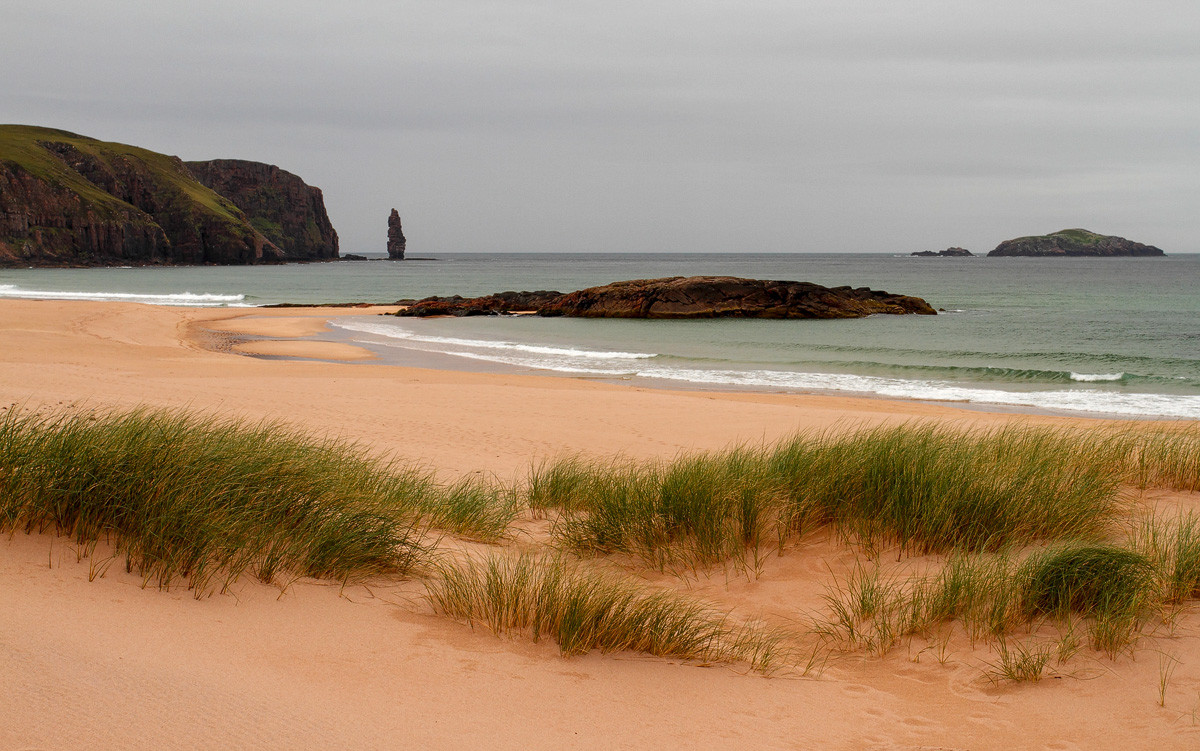
Sandwood Bay is a mile and a half of pinkish sand backed by huge dunes, a freshwater loch and cliffs, with the sea stack of Am Buachaille standing guard at the southern end. There’s no road to it. You park at Blairmore, north-west of Kinlochbervie, and walk roughly four miles each way across open moorland on a clear track that gets wetter and rougher towards the end. Allow around two hours in each direction, and longer if the wind is against you.

The bay and the surrounding Sandwood Estate are cared for by the John Muir Trust, and the estate is still actively crofted, so dogs need to stay on leads and gates should be left as you found them. If the Blairmore car park is full, the Trust asks visitors to use its other car parks at Polin, Dromin or Sheigra rather than the verges.
Sandwood has a reputation for ghosts, mermaids and shipwrecks, and once you’re standing on that beach in fading light with nobody else around, it’s easy to see why the stories took hold. The name itself goes back to the Norse, who called it something close to “sand water”.
Cape Wrath
Six miles north along the coast is Cape Wrath, the north-western corner of the British mainland. Despite the ominous sound of it, the name comes from the Old Norse hvarf, meaning turning point - this was where Viking ships changed course for home.
Getting there is half the fun. From Keoldale, just south of Durness, a small passenger ferry crosses the Kyle of Durness. On the other side, a minibus trundles about 11 miles along an isolated track to the lighthouse, which Robert Stevenson built in the late 1820s on cliffs high above the Atlantic. The bus is limited to 15mph, so the trip takes about an hour each way. The ferry is tide-dependent, the service is seasonal, and the whole area is a Ministry of Defence range - when red flags are flying for live firing, nobody goes in.

Making a Trip of It
The far north-west is perfect for combining with a section of the North Coast 500. Before or after, it’s worth spending time in Assynt, where Ardvreck Castle, the Bone Caves at Inchnadamph and the Wailing Widow Falls are all within easy reach. Fuel stations are thin on the ground up here, so check our guide to NC500 petrol stations before you go, and keep an eye on the Durness midge forecast in summer.
Who it suits: walkers, photographers and anyone already touring the north coast. Who it doesn’t: those with limited mobility - both places need some walking, and Sandwood needs a fair bit.
3. Harris and Lewis - Beaches, Standing Stones and the Edge of the World
Lewis and Harris are actually one island, split by a mountainous boundary into two very different halves. Lewis in the north is broad, flat and peaty, scattered with crofting townships and prehistoric sites. Harris in the south is rocky and mountainous on the east, and on the west it has some of the finest beaches in Europe.
The Beaches of West Harris
Luskentyre is the one everyone photographs, and with good reason. At low tide the sands stretch for miles, and on a bright day the water shifts between turquoise and deep blue in a way that people genuinely struggle to believe is Scotland. Seilebost, just round the corner, is nearly as good, and a detour along the single-track road to Huisinis gives you another beach at the end of the road. If you want to see how these compare with the rest of the country, take a look at our guide to the best beaches in Scotland.

The Calanais Standing Stones
On Lewis, the Calanais Standing Stones are one of the most impressive prehistoric monuments in Britain. Historic Environment Scotland dates them to between 2900 and 2600 BC, which means they were standing before the main circle at Stonehenge. The layout is unusual: a central circle around a tall monolith, with rows of stones radiating out in a rough cross shape. Nobody knows for certain why they were built, though one strong theory links them to an 18.6-year lunar cycle, when the moon appears to skim very low over the southern hills.
The stones are free to visit and open year-round, and the visitor centre, run by the local Urras nan Tursachan trust, reopened in 2026 after a major redevelopment. Don’t miss the smaller circles nearby, known as Calanais II and III, which most people drive straight past.

Harris Tweed
Harris Tweed is the only fabric in the world protected by its own Act of Parliament. Under the Harris Tweed Act 1993, it can only carry the name if it has been handwoven by islanders at their homes in the Outer Hebrides, finished in the islands and made from pure virgin wool dyed and spun there. Every certified length is stamped with the Orb mark by the Harris Tweed Authority. You can visit weavers and shops across both islands, and buying a piece directly from the people who made it is one of the best souvenirs Scotland has to offer.

The Ultimate Detour: St Kilda
If you want to go further still, St Kilda is about as far as Scotland goes. The archipelago lies out in the Atlantic west of the Outer Hebrides, and its last residents were evacuated in 1930 after centuries of extraordinary isolation. Today it’s owned by the National Trust for Scotland and holds dual UNESCO World Heritage status for both its natural and cultural importance. The seabird colonies are vast, and the cliffs and sea stacks are among the highest in Britain.
Day trips leave from Leverburgh on Harris, the shortest crossing, which takes roughly two hours and 45 minutes each way. Kilda Cruises and Sea Harris both run from there, and Go to St Kilda sails from Stein on Skye. Expect a very long day, a price of over £200 per person and no guarantee of landing - trips only go when the sea allows, so build some flexibility into your plans.

Getting to Harris and Lewis
CalMac ferries sail from Ullapool to Stornoway and from Uig on Skye to Tarbert on Harris, and there are flights into Stornoway from Edinburgh, Glasgow and Inverness. Our guide to visiting Stornoway is a good starting point. If you have time, carry on south through the Uists to the Isle of Barra, where scheduled flights land on the beach at Traigh Mhor.
Who it suits: beach lovers, photographers, history fans and anyone wanting Gaelic culture at its strongest. Who it doesn’t: those hoping for much open on a Sunday - many island businesses still close, and it’s worth respecting that.
4. Orkney - Five Thousand Years in a Day
Orkney lies just a few miles off the north coast of Caithness, but crossing the Pentland Firth feels like arriving somewhere else entirely. The landscape is low, green and farmed, and the Norse influence runs deep - Orkney was only pledged to the Scottish Crown in 1468. What really sets it apart, though, is the density of prehistoric remains. The Heart of Neolithic Orkney is a UNESCO World Heritage Site, and you can see a staggering amount of it in a single day.
The Neolithic Heart
- Skara Brae - a 5,000-year-old village so well preserved you can see stone beds, dressers and hearths inside the houses
- The Ring of Brodgar - a huge stone circle set on a narrow strip of land between two lochs
- The Stones of Stenness - fewer stones, but some of the tallest and among the oldest in Britain
- Maeshowe - a chambered cairn aligned so that the setting sun shines down its entrance passage around the winter solstice, with Viking graffiti carved inside

What You Can No Longer See - the Ness of Brodgar
This is the detail many older guides get wrong. Between the Ring of Brodgar and the Stones of Stenness lies the Ness of Brodgar, a complex of monumental Neolithic buildings discovered in 2003 and dug every summer for two decades. It made headlines worldwide for its painted walls, decorated stone and evidence of tiled roofs. The final excavation season ended in August 2024, and the site has since been covered with protective membrane and backfilled.
So there is no open dig to visit any more. Research continues through post-excavation analysis of the finds, and you can still stand on the spot between the two great stone settings and understand why this narrow strip of land mattered so much. Just don’t plan your trip around seeing the trenches.

Beyond the Stones
Orkney has much more than archaeology. The Italian Chapel on Lamb Holm, built by Italian prisoners of war from two Nissen huts during the Second World War, is a remarkable thing to see. St Magnus Cathedral in Kirkwall glows red in the evening light. And if you head to the northern isles, you can take the world’s shortest scheduled flight: Loganair’s hop between Westray and Papa Westray covers about 1.7 miles and has been flown in 53 seconds. You even get a certificate.
From the Moray coast, Orkney is closer than many people assume. A morning’s drive to Scrabster and a 90-minute crossing to Stromness gets you there, and that ferry sails right past the Old Man of Hoy, a 137-metre sea stack that is a sight in its own right. Northlink also sails from Aberdeen to Kirkwall, and Pentland Ferries and the John o’ Groats summer passenger ferry offer shorter crossings. For much more detail, see our Orkney travel guide.

Who it suits: history lovers above all, plus anyone wanting an island trip with good food, good roads and plenty to do. Who it doesn’t: honestly, it suits almost everyone - it’s the easiest of the five to enjoy.
5. Shetland - Britain’s Northern Frontier
Shetland is the furthest you can go in Scotland and still be in a lively, well-served place. Lerwick is closer to Bergen in Norway than it is to Edinburgh, and the islands’ Norse heritage shows in the place names, the dialect and the famous fire festival. The getting there is part of the experience: NorthLink’s overnight ferry from Aberdeen takes about 12 hours direct, or 14 if it calls at Kirkwall, and there’s something special about falling asleep in one place and waking to the sight of Lerwick harbour.
Unst and Hermaness
Head as far north as you can, via two short ferry crossings to Yell and then Unst, and you reach Hermaness National Nature Reserve. Here a boardwalk crosses the moor to cliffs up to 170 metres high, looking out to Muckle Flugga lighthouse - built by the Stevenson engineering family in the 1850s - and Out Stack, the northernmost scrap of the British Isles.
The wildlife is overwhelming. Around 25,000 pairs of gannets nest on the outlying rocks and stacks, and the moorland is patrolled by great skuas, known locally as bonxies, which will dive at you if you stray from the path in nesting season. Puffins, or tammie norries, nest along the clifftops from late spring into summer. The gannets stay on until around September, so even an early autumn visit is worthwhile. NatureScot advises staying overnight on Unst rather than trying to do it as a day trip from Lerwick.

Unst also has a habit of collecting northernmost titles - the northernmost brewery, bus stop and castle among them - and it has entered the space age as home to the SaxaVord spaceport. There’s a nice contrast in standing among 25,000 pairs of gannets on an island that’s also preparing to launch rockets.
Up Helly Aa
If you can face Shetland in January, Lerwick’s Up Helly Aa is one of the great festivals of Europe. It’s held on the last Tuesday of the month, when up to a thousand torch-carrying guizers march through the town before setting fire to a full-size replica Viking galley. Since 2023, women and girls have been able to join the Lerwick squads, and in 2027 the junior festival will have its first female Junior Jarl. Accommodation books up a long way ahead, so plan early.

Elsewhere on the islands, Sumburgh Head in the far south has puffins within easy reach of the car park, and Shetland’s waters are among the best places in Britain to see orcas in Scotland. For more on where to see seabirds, our guide to puffins in Scotland covers the best colonies.

Who it suits: wildlife watchers, festival-goers and anyone curious about Scotland’s Nordic side. Who it doesn’t: anyone with only a weekend - you need at least four or five days to do Shetland justice.
Making the Journey Work
The common thread with all five escapes is that the journey needs as much planning as the destination. A few things I’d always keep in mind:
- Book ferries early. Island car spaces in summer can sell out weeks ahead, and the Knoydart ferry needs booking for all winter sailings.
- Build in a spare day. Weather cancels boats, especially to St Kilda and across the Pentland Firth. A buffer day turns a cancellation from a disaster into a minor inconvenience.
- Don’t over-schedule. Trying to fit Orkney and Shetland into a long weekend means spending most of it on boats. Pick one and do it properly.
- Think about midges. The west coast in July and August can be brutal. Our guide to midges in Scotland explains how to avoid the worst.
- Respect the places you visit. Many of these areas are working crofts and fragile habitats. The Scottish Outdoor Access Code is worth reading before you go.
For most people, the slow route is part of the appeal. Driving north, taking the train to Mallaig or sleeping on the overnight boat to Lerwick all add something to the trip. But for visitors coming from London, from abroad, or with only a few days to spare, the maths can change. Chartering a private jet into one of the region’s larger airports, such as Inverness, Kirkwall, Sumburgh or Stornoway, can turn a full day of connections into a couple of hours in the air. It makes most sense when a group shares the cost - a family gathering in Orkney, say, or a party of walkers heading for the far north-west - and it means more of your precious time is spent on the beach or the hill rather than in departure lounges.
When to Go
Late May and June bring the longest days and the seabird colonies at their busiest, with puffins on land from roughly May to early August. September is often the sweet spot for the west: quieter roads, fewer midges and gannets still at Hermaness. Winter is for the brave, but it brings the best chance of the Northern Lights - Shetland and Orkney are two of the best places in Britain for them - as well as Up Helly Aa. See our guides to dark skies in Scotland and the best time of year to visit Scotland for more.
Not Quite That Far? Five Closer Escapes
If you love the idea of all this but can’t spare the time this year, these places give you a taste of the same wildness without such a long journey:
- Isle of Mull - eagles, Tobermory and boat trips to Staffa and the Treshnish Isles, all reachable from Oban
- Duncansby Head and Stacks - dramatic sea stacks and seabird cliffs just beyond John o’ Groats
- Isle of Skye - busy in summer, but quiet corners remain if you go early or late in the season
- Bass Rock - one of the world’s largest gannet colonies, a short boat trip from North Berwick
- Ailsa Craig - a granite island in the Firth of Clyde with its own seabird city
Frequently Asked Questions
What is the most remote place you can visit in mainland Scotland?
Knoydart is often called the most remote part of mainland Britain because it has no road connection at all. You reach Inverie by a 25 to 40 minute ferry from Mallaig or a walk of around 18 miles. Cape Wrath is similarly isolated, reached only by a passenger ferry and minibus along a private track.
How do you get to Knoydart without a car?
Take the train or the Jacobite Steam Train to Mallaig, then the Western Isles Cruises passenger ferry to Inverie. The ferry runs year-round, but winter sailings must be booked in advance and all sailings are weather dependent. Cars are not carried, so even drivers leave their vehicles in Mallaig.
Can you visit St Kilda on a day trip?
Yes. Boats run from Leverburgh on Harris, taking roughly two hours and 45 minutes each way, and from Stein on Skye. Trips cost over £200 per person, last a full day and only sail when conditions allow, so landing is never guaranteed.
How long is the walk to Sandwood Bay?
It’s around four miles each way from the John Muir Trust car park at Blairmore, near Kinlochbervie, so roughly 16km there and back. Most people take about two hours in each direction. The path is mostly clear but can be wet and rough in places.
Can you still visit the Ness of Brodgar excavation in Orkney?
No. The final excavation season ended in August 2024 and the site was covered with protective membrane and backfilled. You can still visit the nearby Ring of Brodgar and Stones of Stenness, and research on the finds continues.
How long does it take to get to Shetland?
The NorthLink overnight ferry from Aberdeen to Lerwick takes about 12 hours direct, or 14 hours when it calls at Kirkwall. Flights to Sumburgh are much quicker, and the larger regional airports can also be reached by private charter if time is short.
When is the best time to visit Scotland’s remote islands?
Late May to July is best for long days and seabirds, including puffins. September often brings quieter roads and fewer midges. Winter is ideal for the Northern Lights and Shetland’s Up Helly Aa fire festival in late January, but expect short days and more weather disruption.
Final Thoughts
It’s tempting to treat remoteness as a box to tick - the furthest north, the most remote pub, the shortest flight. But what stays with you from places like these is usually smaller and quieter: the moment the ferry engine drops back and you realise how still Loch Nevis is, or the first view of Sandwood after two hours of moorland, or the noise of a gannet colony that you can smell before you see. None of that happens on a coach tour. You have to give these places time, and in return they give you a version of Scotland that most visitors, and plenty of Scots, never see. If you only manage one of the five this year, I hope it’s the start rather than the end of the list.
All information was correct at the time of writing, please check things like entry costs and opening times before you arrive.

Leave a comment below